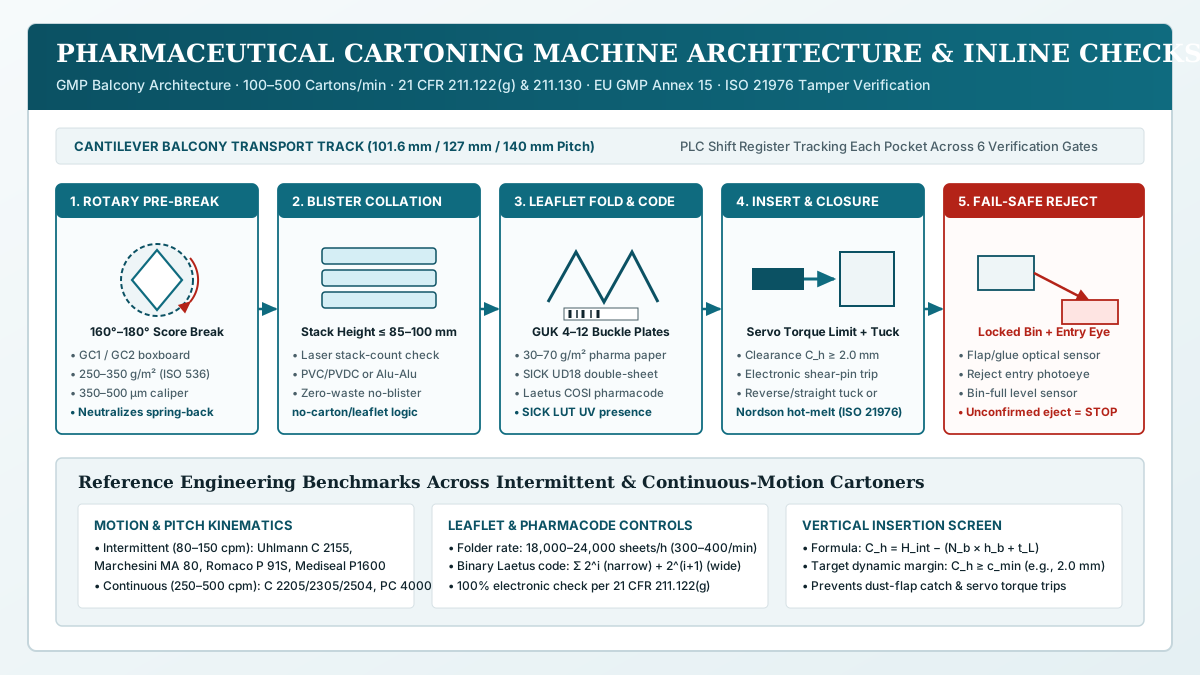
A pharmaceutical cartoning machine assembles primary packs—such as thermoformed or cold-formed blister cards, vials, bottles, or sachets—together with a folded patient information leaflet inside a square, coded, and closed folding boxboard carton. While the parent pharmaceutical cartoning process guide maps the overall secondary-packaging sequence, engineering a reliable blister cartoning line requires specifying the mechanical kinematics, inline leaflet-folder geometry, 100% electronic code and presence sensors, boxboard score pre-breaking, and fail-safe reject verification that prevent line stops and component mix-ups.
Under US 21 CFR 211.122(g) and 21 CFR 211.130, cut labeling, patient leaflets, and outer cartons must undergo dedicated identity and presence verification—most commonly via 100% electronic barcode and luminescence checks coupled to shift-register tracking and locked reject verification. This engineering guide details how to specify and qualify those subsystems and translate them into testable fields in the packaging equipment URS checklist.
Intermittent vs. continuous-motion cartoning machine benchmarks
Selecting between an intermittent-motion and a continuous-motion cartoning machine is governed by required net output (good cartons per minute), blister stack height, carton pitch, and how much axial acceleration the primary pack can tolerate during pusher insertion.
In an intermittent-motion cartoner, the main transport chain indexes forward by one pitch and comes to a complete stop for approximately 200 to 300 ms while a single mechanical or servo pusher inserts the blister stack and leaflet into the stationary carton. In a continuous-motion cartoner, the product bucket chain, leaflet transfer fingers, and carton transport lugs run at constant linear velocity; multiple barrel-cam or linear-servo pushers travel alongside the moving chains and slide the blister stack and wrapped leaflet smoothly into the carton over several machine pitches.
| OEM & Representative Models | Motion Architecture & Pitch | Rated Output (Cartons/min) | Carton Size Range A × B × H (mm) & Stack Limit |
Core Carton Erection, Leaflet & Closure Features |
|---|---|---|---|---|
Uhlmann C 2155 |
Intermittent horizontal; 140 mm pitch |
Up to 150 cpm |
Up to 115 × 100 × 170 mm; blister stack height up to 95 mm |
Cantilever GMP balcony design; rotary carton pick-up with mechanical pre-break; interchangeable tuck-in or hot-melt closing unit; inline GUK leaflet folder |
Uhlmann C 2205 / C 2305 |
Continuous horizontal; 127 mm (5 in) pitch |
Up to 250–300 cpm |
C 2205: 100 × 90 × 150 mm (stack 85 mm); C 2305: 105 × 105 × 155 mm (stack 100 mm) |
TwinStar / TriStar positive rotary carton erection for critical board grades; encapsulated leaflet-folding unit; servo format changeover (~15 min) |
Uhlmann C 2504 |
Continuous horizontal; 101.6 mm (4 in) pitch |
Up to 500 cpm |
Up to 80 × 90 × 155 mm; blister stack height up to 85 mm |
High-speed blister cartoning line synchronization; positive rotary score pre-break; synchronized servo pusher array; dual high-speed reject lanes |
Syntegon CUK 3000 / CUK 6000 (CUK 3040 / 3060) |
Continuous horizontal; pitch-matched to format | Up to 300–400+ cpm |
Format-dependent across small-volume and multi-blister cartons | Positive rotary carton pre-breaking up to 180°; servo-controlled product pushers with electronic torque overload detection; flat-stack, reel, or pre-folded leaflet feed |
Marchesini Group MA 80 / MA 100 |
Intermittent horizontal; balcony separation | Up to 80–120 cpm |
Multi-format blisters, vials, bottles, and rigid tubes | Full mechanical drive separation from product transport zone; positive vacuum carton opening; tuck-in or hot-melt closure |
Marchesini Group MA 302 / MA 400 |
Continuous horizontal; rotary drum | Up to 300–420 cpm |
High-speed blister and rigid container formats | Multi-head rotary drum carton opening with positive pre-breaking; high-speed servo pushers; integrated leaflet folder with inline pharmacode and presence sensors |
Romaco Promatic P 91 / P 91S |
Intermittent horizontal; GMP balcony | Up to 120–140 cpm |
Standard pharma formats (6.5 kW, 100 Nl/min air) |
Venturi vacuum generation; positive carton opening; zero-waste logic (carton and leaflet fed only when upstream blister stack is confirmed) |
Romaco Promatic PC 4000 (PC 4250 / 4300 / 4400) |
Continuous horizontal; servo electronic cams | Up to 400–420 cpm |
PC 4250: 20–120 × 15–80 × 60–210 mm (7.5–9.5 kW, 200–400 Nl/min) |
Positive mechanical carton pick-up and pre-break; Nordson hot-melt or tuck closure; integrated Laetus pharmacode verification |
Körber Mediseal P1600 / P3200 & IMA Safe DYNAMICA |
Intermittent (P1600: 10–150 cpm) & continuous (P3200: up to 300 cpm) |
10–150 cpm / 300 cpm |
P1600/P3200: Length 65–200 mm, Width 35–150 mm, Height 15–110 mm |
Direct track synchronization with upstream thermoforming/cold-forming blister machines; servo pusher overload protection; modular serialization and tamper-evident stations |
When connecting upstream blister thermoforming or cold-forming speed to the cartoner in packaging-line selection, size the cartoning machine in good cartons per minute at a stated blister count per pack, with a 10–15% speed overcapacity margin so the cartoner can drain the transfer buffer without backing up the blister die punch.
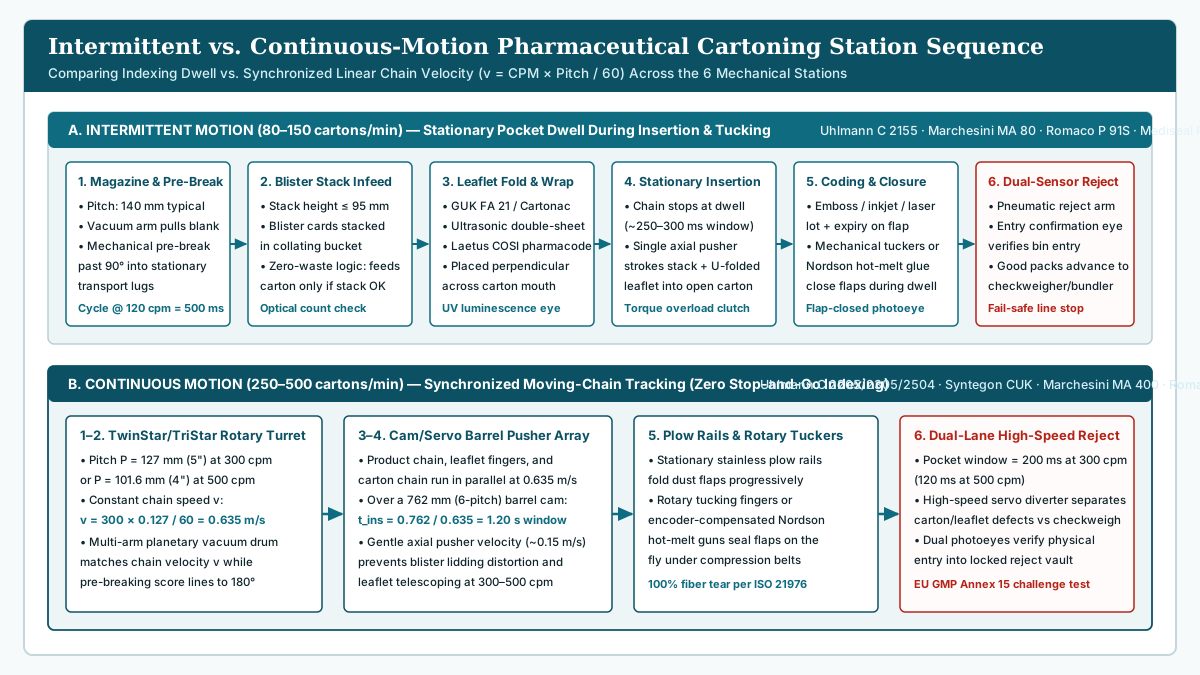
Worked kinematics example: chain velocity and pusher insertion window at 300 cartons/min
A common specification mistake in pharmaceutical cartoning is assuming that doubling line speed doubles the axial impact velocity of the product pusher against the blister stack. Comparing an intermittent cartoner at 120 cartons/min against a continuous-motion cartoner at 300 cartons/min illustrates why continuous tracking protects fragile blisters and thin leaflets at high speed:
- Intermittent cartoner at 120 cartons/min (
P = 140 mmpitch):- Total cycle period:
T_cycle = 60 s / 120 cartons = 0.500 s(500 ms). - Approximately half of the cycle (
250 ms) is consumed indexing the chain140 mmforward and decelerating to rest, leaving a stationary dwell window oft_dwell = 0.250 s(250 ms). - For a pusher stroke of
S_p = 180 mm(forward insertion) plus180 mmretraction during the stationary dwell, the forward insertion stroke must complete in roughly0.150 s, requiring an average axial pusher velocity ofv_push = 0.180 m / 0.150 s = 1.20 m/s(and peak sinusoidal velocity near1.88 m/s).
- Total cycle period:
- Continuous-motion cartoner at 300 cartons/min (
P = 127 mm/5-inchpitch, e.g., UhlmannC 2205 / C 2305):- Linear transport chain velocity:
v_chain = (300 cartons/min × 0.127 m) / 60 s/min = 0.635 m/s(38.1 m/min). - Pocket-to-pocket period passing any fixed sensor:
T_pocket = 60 s / 300 = 0.200 s(200 ms). - Because the barrel-cam or linear-servo pusher array travels horizontally at
0.635 m/sin lockstep with the carton and blister buckets over a6-pitchinsertion zone (L_zone = 6 × 0.127 m = 0.762 m), the available forward insertion window is:t_ins = L_zone / v_chain = 0.762 m / 0.635 m/s = 1.20 s(1,200 ms). - Completing the same
0.180 maxial insertion stroke over1.20 sreduces average axial pusher velocity tov_push = 0.180 m / 1.20 s = 0.150 m/s—an 8× reduction in axial insertion speed despite running 2.5× more cartons per minute.
- Linear transport chain velocity:
Even on a 500 cartons/min continuous-motion line with a 101.6 mm (4-inch) pitch (such as the Uhlmann C 2504), linear chain speed rises only to v_chain = (500 × 0.1016 m) / 60 = 0.847 m/s, keeping axial insertion smooth while reducing the downstream reject gate window to 120 ms per pocket.
Inline leaflet folding and the 6-gate verification chain
Patient information leaflets in pharmaceutical cartoning are printed on lightweight opaque Bible or pharmaceutical paper (30–70 g/m², with heavier inserts or outserts reaching 180 g/m²) and must be folded tightly enough to wrap around the leading face of the blister stack without catching the carton dust flaps.
Inline pharmaceutical folders—such as the G&K-Vijuk / GUK FA 21/4, FA 21/6 SVA, and Cartonac 91 / Cartonac 2000 or Herzog+Heymann buckle-and-knife units—handle flat sheet sizes from 60 × 105 mm up to 210 × 320 mm at rated throughputs of 18,000–24,000 sheets/hour (300–400 leaflets/min). A vacuum suction wheel or reciprocating sucker pulls the bottom or top sheet from the magazine (or a rotary cutter severs a web from a reel) and drives it through 4 to 12 parallel buckle plates to form a flat accordion (Z-fold), parallel fold, or cross-knife booklet.
As the folded leaflet exits the rollers, mechanical transfer fingers or a U-forming mandrel position the leaflet perpendicular to the product pusher path. When the servo pusher advances the collated blister stack, the stack sweeps the leaflet into a U-wrap around the leading edge of the blisters and carries both components together into the open carton.
Six mandatory inline verification gates
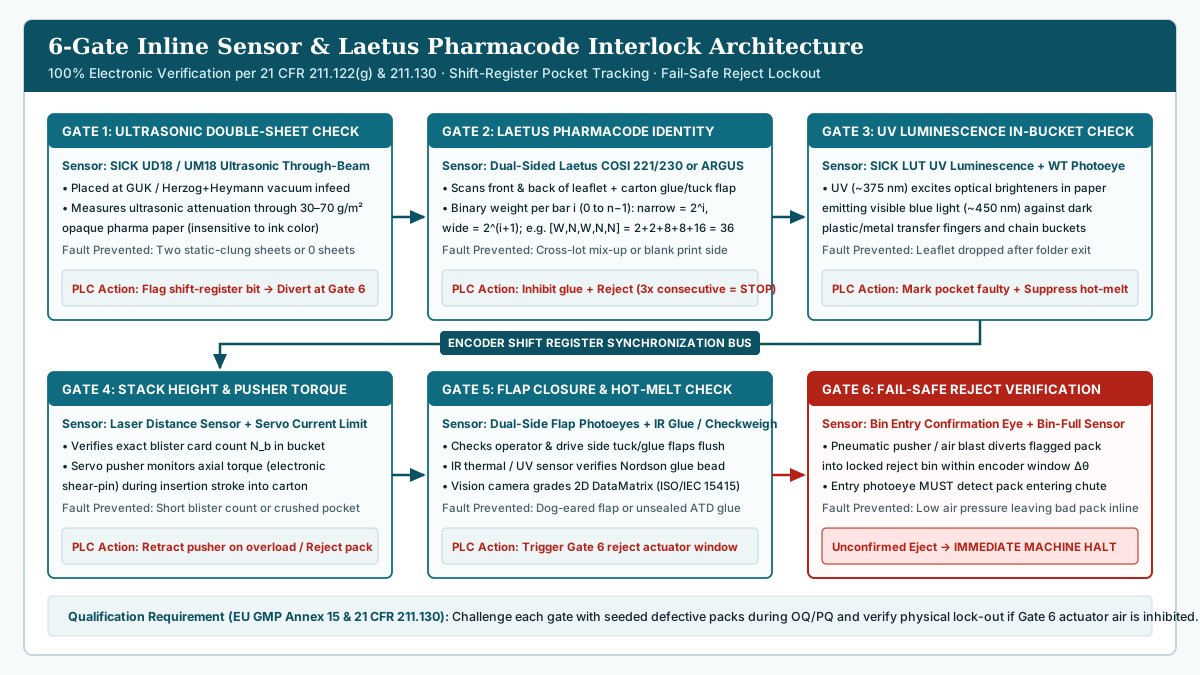
Because a missing, double-fed, blank, or cross-lot leaflet constitutes a critical labeling defect under 21 CFR 211.122(g) and 21 CFR 211.125, a compliant blister cartoning line interlocks six sequential sensor gates through the machine’s encoder-driven shift register:
| Gate & Station Location | Sensor Technology & Representative Hardware | Target Failure Mode Prevented | PLC Shift-Register & Machine Response |
|---|---|---|---|
| Gate 1: Leaflet feeder infeed | Ultrasonic through-beam double-sheet detector (SICK UD18 / UM18) |
Two static-clung sheets pulled simultaneously, or missed vacuum pickup (0 sheets) |
Flags target pocket in shift register; diverts double sheet at folder trap or routes finished carton to reject bin |
| Gate 2: Leaflet & carton identity | Dual-sided optical binary pharmacode scanner (Laetus COSI 221 / 230 or ARGUS wt) or 2D DataMatrix camera |
Cross-lot mix-up, wrong strength or language revision, or unprinted blank side on leaflet or carton flap | Inhibits hot-melt glue gun (if applicable), marks pocket for rejection, and halts cartoner after N (typically 3) consecutive read faults |
| Gate 3: Leaflet presence in transfer bucket | UV luminescence sensor (SICK LUT series exciting optical brighteners at ~375 nm) + background-suppression photoeye (SICK WT series) |
Leaflet dropped between buckle folder exit and U-wrapping mandrel, or skewed leaflet protruding from bucket | Marks target carton pocket faulty in shift register; suppresses glue application; routes pack to reject station |
| Gate 4: Blister stack count & pusher stroke | Laser/optical stack-height triangulation sensor in collating bucket + servo drive current/torque monitor (electronic shear-pin) | Incomplete blister count (e.g., 2 cards instead of 3), cocked blister card, or crushed primary blister cavities |
Servo pusher retracts immediately if axial force/torque exceeds preset limit (N·m); incomplete stack flagged for rejection |
| Gate 5: Flap closure, glue bead & variable coding | Operator/drive-side flap photoeyes + IR thermal or UV adhesive bead sensor + 2D vision camera (ISO/IEC 15415) + dynamic checkweigher |
Dog-eared dust flap, popped tuck tongue, missing hot-melt bead, unreadable lot/expiry code, or gross weight deviation | Triggers Gate 6 reject actuator; separates coding/closure faults from checkweigher rejects on dual-lane systems |
| Gate 6: Fail-safe reject confirmation | Pneumatic reject pusher/air blast + reject bin entry confirmation photoeye + lockable bin full-level sensor | Low compressed-air pressure or solenoid lag allowing a flagged defective carton to stay on the good-pack conveyor | Immediate machine stop and fault lock-out if the reject entry photoeye is not blocked within the encoder window for a flagged pocket |
Worked example: binary Laetus pharmacode encoding and verification
To prevent mixing leaflets or cartons from different strengths or language markets under 21 CFR 211.122(g), pharmaceutical artwork prints a binary Laetus pharmacode along the leaflet fold path and on the carton glue or tuck flap. Unlike retail EAN/UPC or unit-dose hospital barcodes, pharmacode uses a single track of n parallel bars (1 to 16 bars, representing integers from 3 to 131,070) composed of narrow bars (0.5 mm standard width) and wide bars (1.5 mm standard width) separated by 1.0 mm white spaces.
Reading the bars from right to left at zero-based position index i = 0, 1, 2, ..., n − 1:
- A narrow bar at position
icontributes2^ito the code sum. - A wide bar at position
icontributes2^(i + 1)to the code sum.
Worked calculation for a 5-bar leaflet pharmacode:
Suppose the approved packaging master batch record specifies a 5-bar sequence read right-to-left (i = 0 to 4) as [Wide, Narrow, Wide, Narrow, Narrow]:
i = 0(Wide):2^(0 + 1) = 2^1 = 2i = 1(Narrow):2^1 = 2i = 2(Wide):2^(2 + 1) = 2^3 = 8i = 3(Narrow):2^3 = 8i = 4(Narrow):2^4 = 16- Decoded integer value:
V = 2 + 2 + 8 + 8 + 16 = 36.
During line clearance and batch setup, the supervisor enters 36 into the Laetus ARGUS or PLC recipe controller. Dual COSI 221/230 optical heads mounted on opposite sides of the leaflet track verify both that the decoded value equals 36 and that printing is present on both faces of the sheet (catching single-sided blank print faults on duplex jobs).
Folding boxboard mechanics, rotary pre-breaking, and vertical clearance
Even when sensors function properly, mechanical jams at the insertion and tucking stations account for the majority of unplanned stops on a blister cartoning line. Preventing those stops requires matching the folding boxboard specification and internal carton dimensions to the blister stack and folded leaflet profile.
Boxboard grades, grain direction, and rotary pre-breaking
Pharmaceutical outer cartons are converted from virgin-fiber folding boxboard—primarily GC1 (coated white-back folding boxboard / solid bleached board) or GC2 (coated cream-back folding boxboard with a high-bulk mechanical pulp middle ply that delivers higher bending stiffness per unit basis weight):
- Basis weight (grammage per ISO 536): Typically
250–350 g/m², scaled to carton volume and blister count. - Caliper (thickness per ISO 534): Typically
350–500 µm(0.35–0.50 mm), specified within±5%(±15–20 µm) across converter lots so rotary vacuum pick-up arms and plow clearances do not require retuning at pallet changes. - Bending stiffness and grain direction (ISO 2493-1 / DIN 53121): Measured at a
15°bending angle over a50 mmtest span. Die-cut blanks must orient the paperboard Machine Direction (MD) grain perpendicular to the four main longitudinal score lines (parallel to the carton width/depth panels). This maximizes panel stiffness against bowing when the vacuum turret pulls the flat sleeve open. - Warehouse conditioning (ISO 187): Reference testing occurs at
23°C ± 1°Cand50% ± 2% RH. Cartons stored below35% RHsuffer score-line cracking and high elastic spring-back, whereas storage above65% RHsoftens tuck tongues and causes dog-eared flaps during high-speed plow folding.
Because palletized flat carton sleeves retain elastic memory along their four longitudinal creases, opening a carton to 90° leaves residual recovery torque that pulls the cross-section back toward a diamond shape. Modern cartoners (such as Uhlmann’s TwinStar/TriStar turrets, Syntegon CUK rotary openers, and Romaco PC 4000 positive openers) execute rotary pre-breaking: vacuum suckers grip adjacent carton panels and over-fold the longitudinal score lines past 90°—up to 160°–180°—before releasing the sleeve into the transport lugs at a square 90° angle.
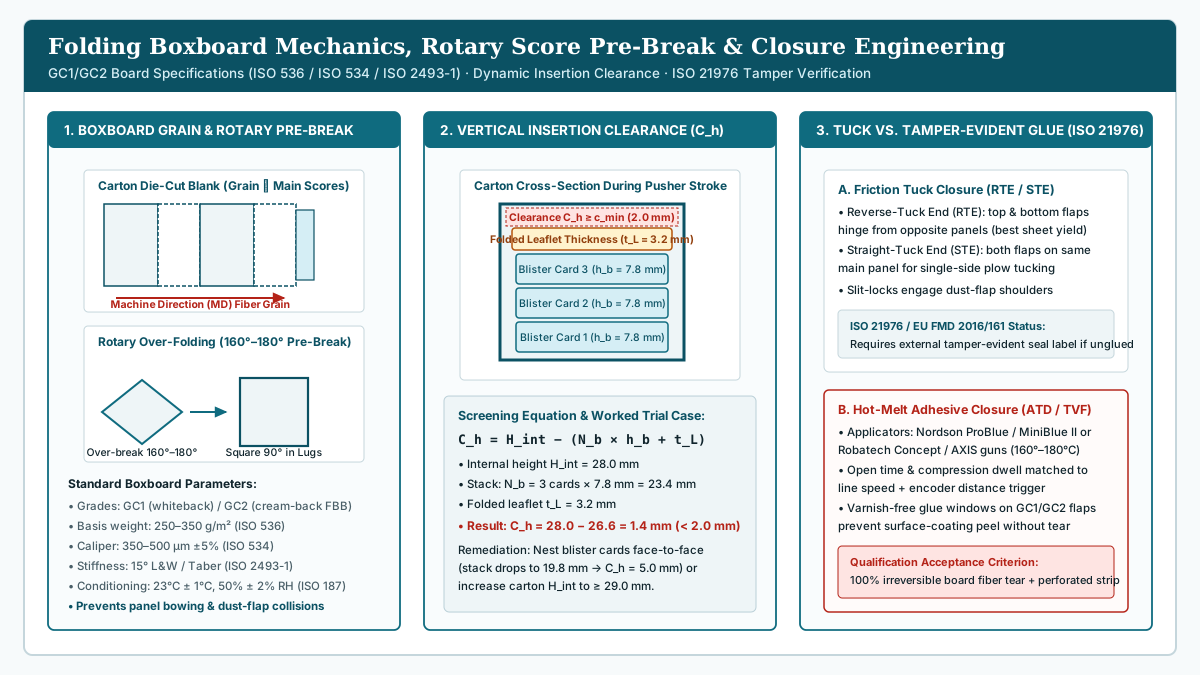
Worked screening model: vertical carton insertion clearance (C_h)
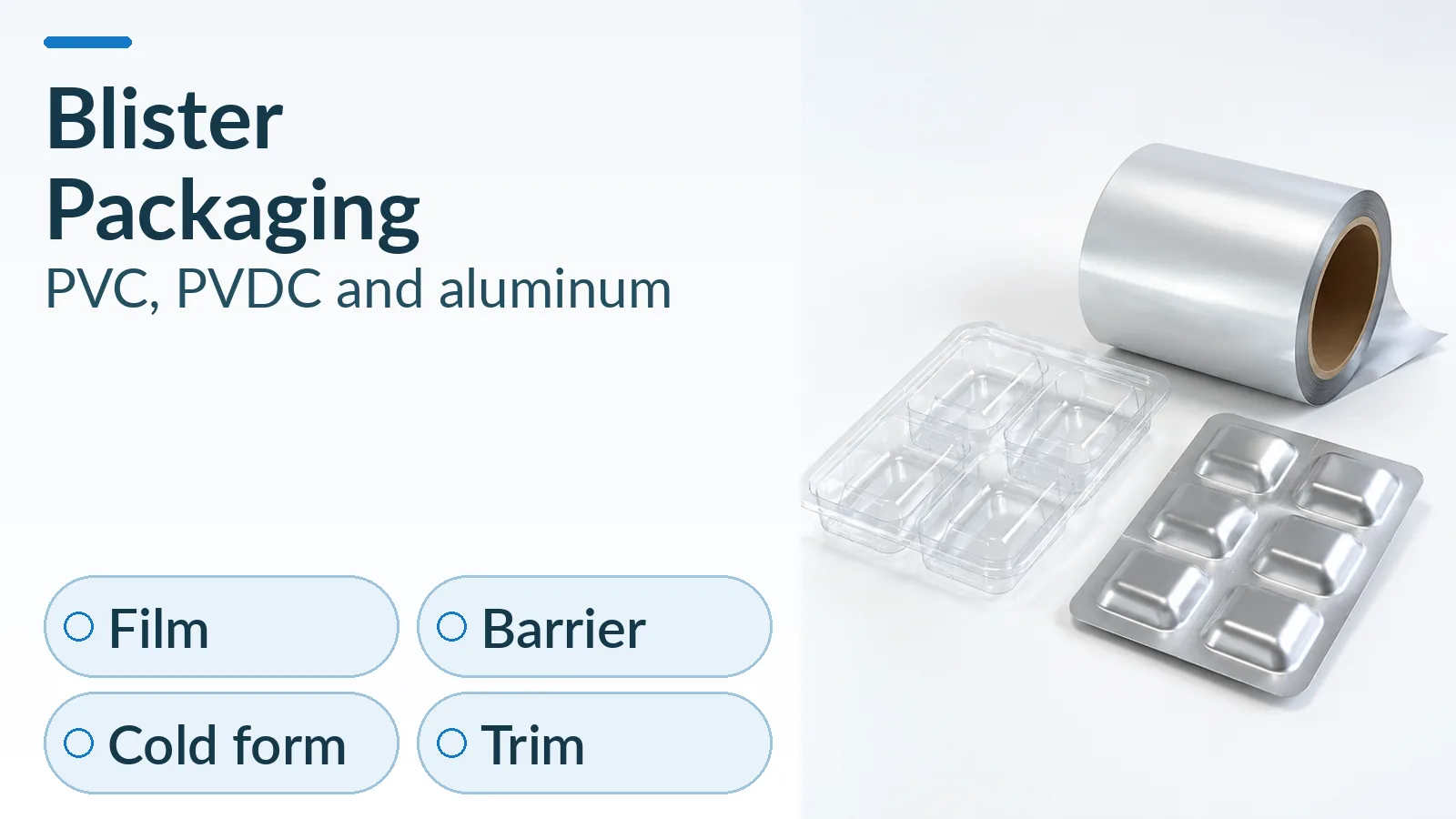
Upstream changes to blister pocket geometry—examined in capsule vs tablet packaging-line requirements—or switching from thermoformed PVC/PVDC to a thicker cold-form laminate—covered in blister packaging materials: PVC, PVDC and cold-form aluminum—directly alter the collated stack height entering the cartoner.
Before cutting carton dies or ordering folding tooling, screen the vertical insertion clearance C_h inside the erected carton mouth:
C_h = H_int − (N_b × h_b + t_L)
Where:
C_h= Vertical dynamic insertion clearance margin (mm)H_int= Minimum internal erected carton height (mm), after subtracting2×board caliper and score fold radiiN_b= Number of blister cards in the collated stackh_b= Maximum single blister card height (mm), including pocket dome height and any thermal bow across the lidding foilt_L= Compressed folded leaflet thickness (mm) wrapped over the top or side of the blister stack
Engineering rule of thumb: If C_h < c_min (where c_min is the required dynamic entry clearance for the machine and guide horn, e.g., 2.0 mm for a standard horizontal pusher stroke), the folded leaflet cap or top blister card will scrub the upper carton panel and dust flaps, causing leaflet telescoping (the stack slides inside the carton while the leaflet crumples at the mouth) or tripping the servo pusher torque limit.
Worked trial calculation:
Consider a 30-tablet pack consisting of N_b = 3 ten-cavity blister cards stacked face-to-back (h_b = 7.8 mm per card), paired with a 4-buckle folded leaflet of thickness t_L = 3.2 mm, inserted into a carton with minimum internal height H_int = 28.0 mm and a target clearance requirement of c_min = 2.0 mm:
- Total stack and leaflet height:
H_pack = (3 × 7.8 mm) + 3.2 mm = 23.4 mm + 3.2 mm = 26.6 mm. - Vertical insertion clearance:
C_h = 28.0 mm − 26.6 mm = 1.4 mm. - Assessment: Because
1.4 mm < 2.0 mm, the configuration has a0.6 mmclearance deficit. Rather than increasing the servo pusher force threshold (which risks crushing primary blister cavities), engineering can resolve the deficit by:- Face-to-face blister nesting: Alternating card orientation in the collating magazine so pockets interleave reduces the 3-card stack height from
23.4 mmto19.8 mm, increasingC_hto28.0 − (19.8 + 3.2) = 5.0 mm. - Leaflet fold adjustment: Moving from a 4-buckle fold to a thinner multi-panel parallel fold on the GUK folder (if carton width permits) reduces
t_Lfrom3.2 mmto2.2 mm(C_h = 2.4 mm). - Carton height revision: Increasing
H_intfrom28.0 mmto29.0 mmyieldsC_h = 2.4 mm.
- Face-to-face blister nesting: Alternating card orientation in the collating magazine so pockets interleave reduces the 3-card stack height from
Tuck-in vs. tamper-evident hot-melt closure (ISO 21976)
Once the blister stack and leaflet are seated inside the carton, rotary or stationary plows fold the dust flaps inward while the end panels pass the variable-data coding head (embossing, thermal inkjet, or UV/CO₂ laser marking lot, expiry, and 2D DataMatrix codes—specified across unit, bundle, case, and pallet tiers in pharmaceutical serialization and aggregation levels) and the closing station.
- Reverse-tuck end (RTE) vs. straight-tuck end (STE) friction closure:
- Reverse-tuck end (RTE) cartons hinge the top and bottom tuck flaps from opposite main panels, allowing adjacent blanks to interlock tightly on the converter’s die-cutting sheet for lower board scrap.
- Straight-tuck end (STE / airplane tuck) cartons hinge both tuck flaps from the same main panel so both closing plows operate from the same side of the cartoner transport track, leaving the full front panel uninterrupted by a raw cut edge.
- Slit-locks (pie-cut notches at the base of the tuck tongue) engage the dust-flap shoulders to prevent the flap from springing open during downstream transport toward pharmaceutical overwrapping or case packing.
- Tamper-evident closure under EU FMD and ISO 21976:2018:
- For prescription medicines subject to Directive 2011/62/EU and Delegated Regulation (EU) 2016/161 (or US OTC products under 21 CFR 211.132), the outer carton must incorporate an Anti-Tampering Device (ATD) / Tamper Verification Feature (TVF) conforming to ISO 21976:2018.
- Standard friction tuck flaps do not satisfy ISO 21976 on their own. Compliance requires either applying tamper-evident vignette labels across both tuck joints after carton closure, or sealing the end flaps with hot-melt adhesive (using applicators such as Nordson
ProBlue / MiniBlue IIor RobatechConcept / AXISsystems operating at160–180°C) paired with a perforated tear-open strip on the carton body. - To guarantee 100% irreversible fiber tear upon opening, carton artwork must leave varnish-free glue windows (
unvarnished board reserves) where the adhesive bead contacts the flaps, and the PLC must compensate gun firing timing across line speed ramps so adhesive open time and compression belt dwell stay within the adhesive’s bonding window.
OQ/PQ challenge-pack matrix and fail-safe reject reconciliation
During Operational Qualification (OQ) and Performance Qualification (PQ) under EU GMP Annex 15 and 21 CFR 211.130, quality and engineering teams must challenge every inline sensor gate using deliberately defective, uniquely marked test packs (for example, high-visibility colored tape or numbered test cartons logged in the validation protocol) at both minimum and maximum qualified machine speeds.
| Challenge Scenario ID | Seeded Defect Introduced at Line Speed | Primary Detection Gate & Sensor | Required Machine & Shift-Register Response | Reconciliation Acceptance Criterion |
|---|---|---|---|---|
| OQ-CHK-01 | Missing leaflet (vacuum pick-up inhibited or sheet removed from magazine) | Gate 2 (Laetus scanner no-read) & Gate 3 (SICK LUT UV luminescence sensor dark) |
Suppress hot-melt glue gun; track pocket via encoder shift register; divert carton into locked reject bin | 10/10 seeded packs diverted to reject bin; 0 passed to good conveyor |
| OQ-CHK-02 | Double-fed leaflet (two sheets taped or fed together into GUK folder) | Gate 1 (SICK UD18 / UM18 ultrasonic attenuation threshold exceeded) |
Eject double leaflet at folder trap or route completed carton to locked reject bin | 10/10 double-sheet events detected and isolated |
| OQ-CHK-03 | Wrong or inverted leaflet / carton (mismatched binary Laetus pharmacode, e.g., code 34 vs 36, or blank face) |
Gate 2 (Laetus COSI 221/230 dual-side bar scanner + flap scanner) |
Divert single mismatch to reject bin; halt cartoning machine automatically on 3rd consecutive mismatch |
10/10 single mismatches rejected; machine stops on 3 consecutive faults |
| OQ-CHK-04 | Incomplete blister stack (N_b − 1 cards loaded into collating bucket) or cocked blister |
Gate 4 (Bucket laser stack-height sensor + servo pusher torque limit) | Retract pusher if torque limit is exceeded; route incomplete pack to reject bin (or downstream checkweigher) | 10/10 short-count packs rejected; zero crushed primary blister cavities |
| OQ-CHK-05 | Unclosed tuck flap / missing hot-melt bead (flap held open or glue gun inhibited) | Gate 5 (Side flap photoeyes + IR/UV glue bead sensor) | Flag pocket at exit of closing compression belts; divert at Gate 6 reject actuator | 10/10 open-flap or unglued cartons diverted to locked reject bin |
| OQ-CHK-06 | Simulated reject actuator failure (faulty pack triggered while reject solenoid air is disconnected) | Gate 6 (Reject bin entry confirmation photoeye fails to see pack enter chute within Δθ window) |
Immediate fail-safe machine halt before the unrejected defective pack exits the cartoner discharge belt | Machine stops on 100% of unconfirmed reject events; manual key-switch reset required |
Carry each of these six challenge tests directly into the acceptance-evidence column of the packaging equipment URS checklist, and consult the pharmaceutical packaging glossary when aligning line-clearance, qualification, and secondary-packaging definitions across operations and quality teams within the pharmaceutical packaging section.