Under 21 CFR 211.132(b)(1), a tamper-evident package is one having one or more indicators or barriers to entry which, if breached or missing, can reasonably be expected to provide visible evidence to consumers that tampering has occurred.
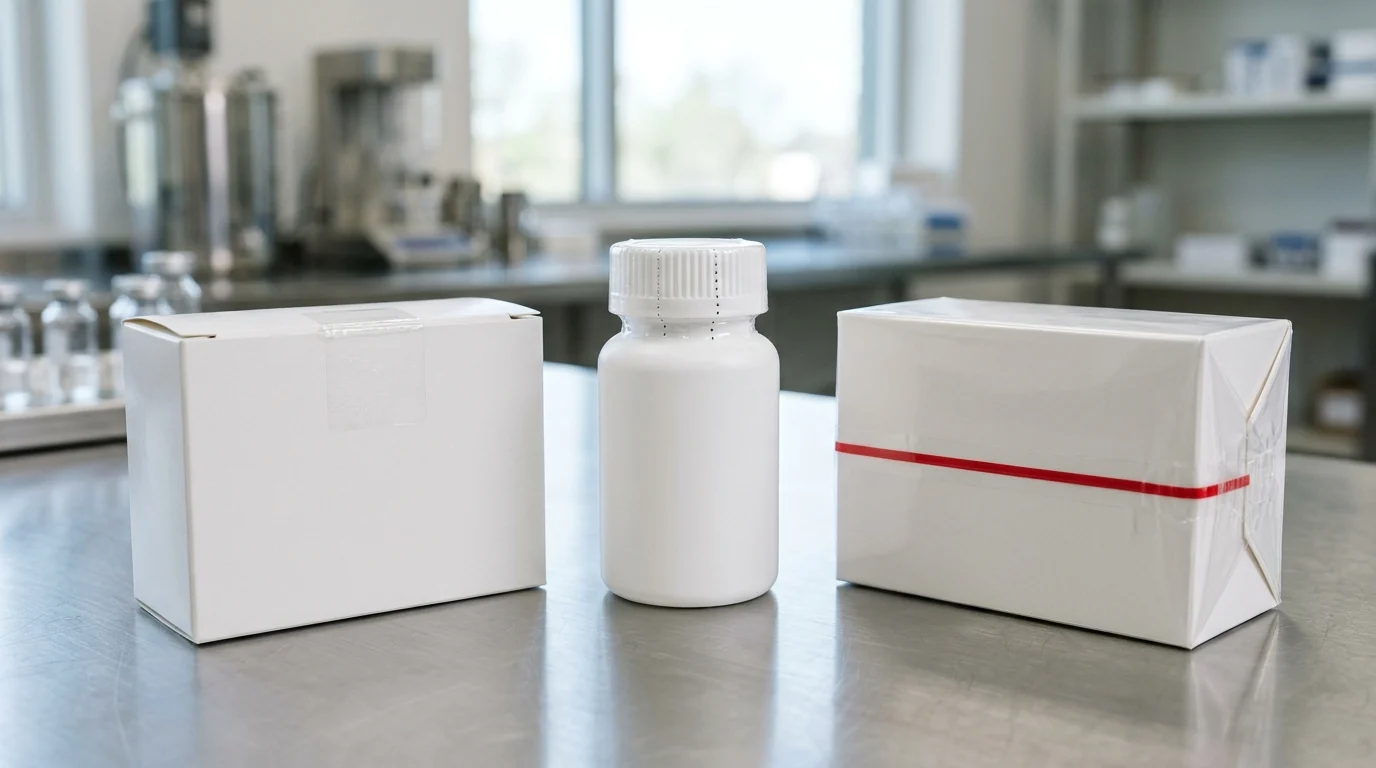
When a closure indicator fails to leave visible damage upon opening, the package cannot alert patients or pharmacists before use, so use this guide to compare folding-carton closure labels, bottle neck shrink bands, and full-carton film overwraps across your pharmaceutical packaging operations and align barrier placement with primary, secondary and tertiary packaging.
Under FDA CPG Sec. 450.500, heat shrink bands or wrappers applied at the juncture of the cap and container must be heat shrunk to provide a tight fit, must be cut or torn to open, cannot be worked off and reapplied without visible damage, and can use a perforated tear strip to enhance tamper-resistance.
Under 21 CFR 211.132(b)(1), a tamper-evident package may involve an immediate-container and closure system or secondary-container or carton system or any combination of systems, and the feature shall remain intact when handled in a reasonable manner during manufacture, distribution, and retail display.
Compare tamper-evident packaging structures
| Decision dimension | Carton closure labels | Bottle neck shrink bands | Full-carton film overwrap |
|---|---|---|---|
| How does first opening leave visible evidence? | Schreiner MediPharm classifies folding-box closure seal destruction mechanisms into three types that can be used and combined: Fiber tear (cardboard surface is destroyed when removed), Film tear (label tears and is irreversibly destroyed when removed), and Void effect (an irreversible text or holographic effect appears on first opening). | According to PDC International, for a shrink neck band to be truly tamper-evident, the neck band must underlap and grip an indented area (neck ring) below the cap so that this area is visibly damaged when the band is removed and the cap is raised to open; otherwise, the cap could be removed and replaced without visible damage. | Under FDA CPG Sec. 450.500, film wrappers must wrap a transparent film securely around the entire product container so the film must be cut or torn to open, achieve a tight fit (e.g., by a shrink-type process), and employ an identifying characteristic that cannot be readily duplicated. |
| Which legacy designs are rejected in US OTC guidance? | Under FDA CPG Sec. 450.500, tape seals relying on an adhesive to bond them to the package are not capable of meeting the TRP requirements because they can be removed and reapplied with no visible evidence of entry; however, technological innovations may produce adhesives which do not permit the removal and reapplication of tape seals, and tape seals must employ an identifying characteristic that cannot be readily duplicated. Under FDA CPG Sec. 450.500, paperboard cartons sealed by gluing the end flaps are not capable of meeting the TRP requirements; however, technological advances may provide sealed paperboard packages that meet the requirements of the TRP regulations. | Under FDA CPG Sec. 450.500, cellulose wet shrink seals are not acceptable because knowledge to remove and reapply these seals without evidence of tampering is widespread, and tinted bands or wrappers are no longer acceptable as an identifying characteristic because tinted material or a facsimile may be available to the public. | Under FDA CPG Sec. 450.500, cellophane with overlapping end flaps is not effective as a tamper-resistant feature because the end flaps can be opened and resealed without leaving visible evidence of entry, and tinted wrappers are no longer acceptable as an identifying characteristic. |
| How are branding and verification features integrated? | To comply with the EU Falsified Medicines Directive (2011/62/EU) and ISO 21976, UPM PharmaSure adhesives such as RP62 EU support tamper-evident seal label options including cardboard tear, void effect, and fragile splitting or breaking, with Red Luminescence technology available for automated presence verification. | CCL Healthcare's tamper-evident bottle shrink neck bands use single-color branding on clear film to display a brand name or security statement and can incorporate security tear strips, taggants, and color-shift inks, while carton seals indicate tampering by leaving behind a void message, label material, or noticeably damaging the packaging. | Compared with BOPP/cellophane box overwrapping (which produces a crystal-clear, flat, crisp folded-end finish with anti-counterfeiting tear tape at 1.5 kW manual/semi-auto or 4.0 kW automatic), PVC/PE shrink wrapping of boxes typically runs at 15–60 cycles/min without mold changes for various box sizes, but consumes 3–8 kW depending on oven power and produces a looser wrap that can show minor distortions. |
Put US OTC and international rules in context
Under 21 CFR 211.132(a), an OTC drug product (except a dermatological, dentifrice, insulin, or lozenge product) for retail sale that is not in a tamper-resistant package or properly labeled is adulterated under section 501 of the act or misbranded under section 502 of the act.
Under 21 CFR 211.132(b)(1), ‘distinctive by design’ means the packaging cannot be duplicated with commonly available materials or through commonly available processes. Under 21 CFR 211.132(b)(1), the package is required to be distinctive by design or by the use of one or more indicators or barriers to entry that employ an identifying characteristic (e.g., a pattern, name, registered trademark, logo, or picture).
Under 21 CFR 211.132(b)(2), in addition to the tamper-evident packaging feature described in paragraph (b)(1), any two-piece, hard gelatin capsule covered by the section must be sealed using an acceptable tamper-evident technology.
Under FDA CPG Sec. 450.500 (May 1992), tamper-resistant packaging regulations cover OTC human drug products (21 CFR 211.132), cosmetic liquid oral hygiene and vaginal products (21 CFR 700.25), and contact lens solutions/tablets (21 CFR 800.12), with two-piece hard gelatin capsules requiring a minimum of two tamper-resistant packaging features unless the capsules are sealed.
Under 21 CFR 211.132(f), tamper-evident packaging requirements do not affect any requirements for ‘special packaging’ (child-resistant packaging) defined under § 310.3(l) and required under the Poison Prevention Packaging Act of 1970.
Labeling statements and reconciliation controls
Under 21 CFR 211.132(c)(1) and (2), each retail OTC drug package (except ammonia inhalant in crushable glass ampules, containers of compressed medical oxygen, or aerosol products) must bear a labeling statement placed so it will be unaffected if the tamper-evident feature is breached or missing, and referencing any identifying characteristic (e.g., ‘For your protection, this bottle has an imprinted seal around the neck.’).
Under FDA CPG Sec. 450.500, placing the TRP labeling statement on bottle caps or solely on package inserts is unacceptable; if the TRP feature is on an outer carton, the inner container (e.g., bottle) needs to bear a statement alerting the consumer that the bottle should be in a carton at the time of purchase.
Under FDA CPG Sec. 450.550 (March 1983), portions of tamper-resistant packaging that contain labeling (such as shrink seals imprinted with the product name) under Section 201(m) of the FD&C Act are subject to the control and accountability provisions of Subpart G of the CGMP regulations, while portions that contact the drug product are subject to Subpart E.
Medicinal tamper verification categories
ISO 21976:2018 (First edition, published 2018-11) is titled ‘Packaging — Tamper verification features for medicinal product packaging’.
According to the Introduction of ISO 21976, the document builds on EN 16679:2014 and supports compliance with Directive 2001/83/EC as amended by Directive 2011/62/EU (Falsified Medicines Directive), whose Article 54(o) stipulates that on the outer packaging (or immediate packaging where there is no outer packaging) must appear ‘a device allowing verification of whether the outer packaging has been tampered with’.
On 30 November 2018, ISO published ISO 21976:2018 based on CEN standard EN 16679:2014 (recommended in EU Commission Q&A version 12 under section 1.14), supporting the EU Anti-Counterfeiting Directive 2011/62/EU and Delegated Regulation 2016/161 mandate effective 9 February 2019 that prescription medicines carry two security features: an individual identifier and an Anti Tampering Device.
In ISO 21976 Clause 3.8, tampering is defined as an ‘unauthorized attempt to open, manipulate or re-use the packaging or elements of it’, and Clause 3.9 defines a tamper verification feature (also referred to in Note 1 as ‘anti-tampering devices’) as characteristics allowing verification (3.10) of whether the outer packaging (3.7) of medicinal products (3.6) or immediate packaging has been opened or tampered with.
In ISO 21976 Clauses 4.2, 4.3, and 4.4, tamper verification features limit the ability to replace the contents of genuine packs, shall not compromise the readability of statutory information including tactile markings, should keep statutory text readable after opening, can increase the physical strength needed to open the packaging, and shall enable a visual check for presence and any evidence of tampering.
ISO 21976 Clause 5 categorizes tamper verification features into folding boxes closed with glue (5.2), specially constructed folding boxes (5.3), sealing labels and tapes (5.4), film wrappers (5.5), sleeves (5.6), breakable or tear-away closure (5.7), container inner seal or membrane (5.8), display blister pack (5.9), flexible packaging (5.10), blow-fill-and-seal-container (BFS) (5.11), and new and emerging technologies (5.12).
Under ISO 21976 Clauses 5.2.1, 5.2.2, and 5.2.3 (Folding boxes closed with glue), hot melt, polyurethane, dispersion or other glues are applied to close the box so that the box cannot be opened without visible signs of tear-off/ripping-off of the carton board surface and/or other parts of the folding box, leading to visible, irreversible damage of the folding box integrity.
Under ISO 21976 Clauses 5.3.1 and 5.3.2 (Specially constructed folding boxes), the feature is activated by inserting the flaps to close the folding box so that the first time the box is opened, parts of the flaps, perforations, scores/half cuts, or folding box are ripped off and/or torn.
Under ISO 21976 Clause 5.4.1 (Sealing labels and tapes), a label or tape (e.g. from paper, film or laminate) is applied in order to seal the packaging of medicinal products, which may incorporate perforations to facilitate opening, and shall provide the integrity of the sealed packaging.
Examine folding-carton closure labels: fiber tear, frangible film, and void seals
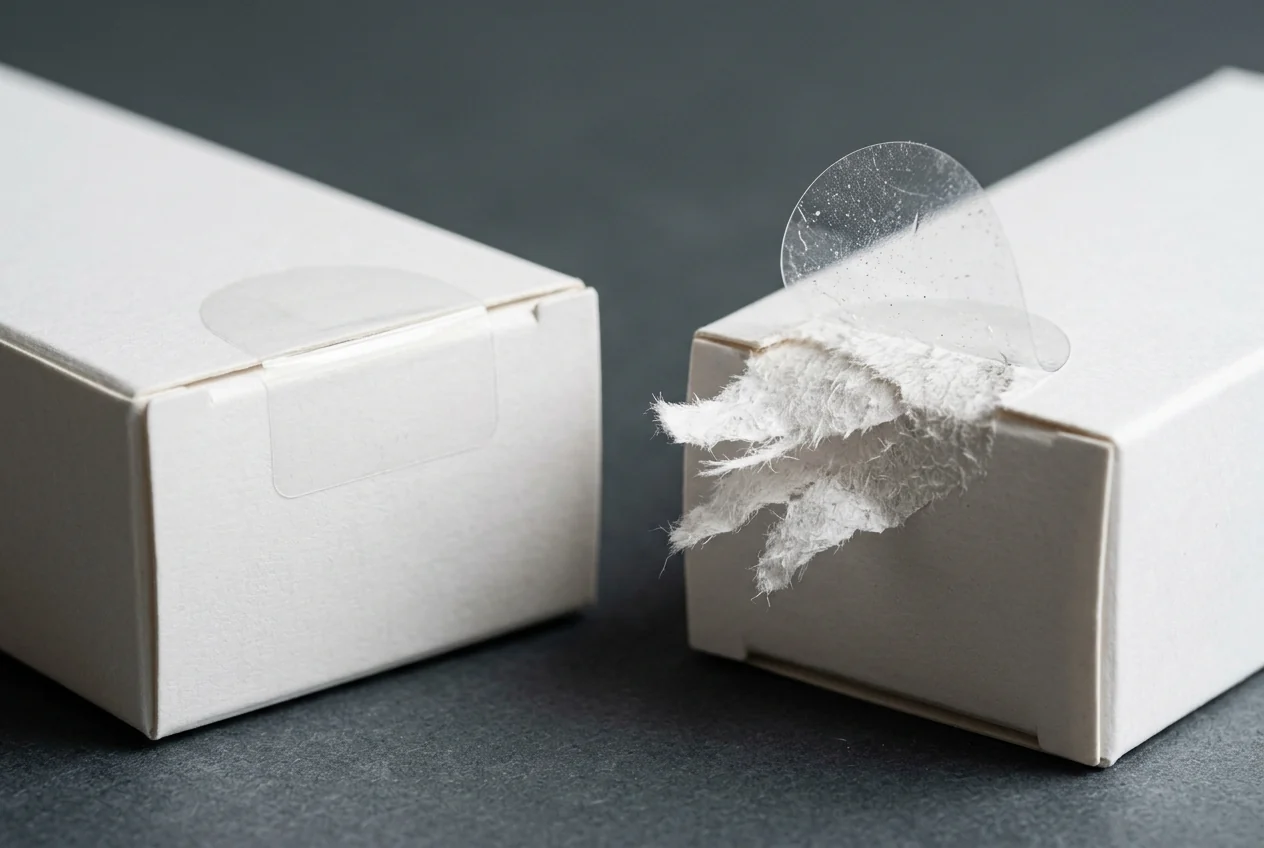
In Avery Dennison’s North America Security Solutions portfolio, fiber tear labels use a permanent adhesive with twice the strength of common alternatives to damage underlying varnish box packaging upon removal, while frangible film labels consist of an engineered film and specially designed adhesive that fragments into tiny pieces upon attempted removal.
Avery Dennison classifies VOID labels into three types: Dry peel VOID (Flexsecure), which leaves a non-tacky filmic message on the substrate and loses all tack once removed; No residue VOID (Removable VOID), which reveals an irreversible void message on the label without leaving any traces of adhesive; and Wet peel VOID (Standard VOID), which leaves a permanent message on the substrate and a visible ‘negative’ on the label.
According to Avery Dennison’s Technical Marketing Bulletin on Fasson Tamper-Evident Polyesters, voidable polyesters require residence time on the substrate to build bond strength to activate the tamper-evident features, normally achieving permanent bonds within 72 hours at normal room temperatures, in 2 mil calipers with a 3 mm checkerboard or ‘VOID’ pattern (Specs 78194–78199 with S8015/S8015W adhesive on 50# SCK liner).
In Avery Dennison’s North America Security Portfolio table, Spec B3585 (2 Mil Clear BOPP TC/S717P/40#BG) is specified for pharmaceutical box fiber tear, Specs 79449 (2 Mil Tamperfas Satin Vinyl/S730/50#SCK ABC) and 60097 (2 Mil Clear Acetate/S730/50#SCK ABC) are frangible films, and Spec 77964 (3 Mil Clear MDO/S692N/1.2M PET) is a machine-direction Sharp Tear film.
Avery Dennison’s SharpTear film is designed to tear cleanly and easily in a single direction using small incisions or notches added at the die-cutting stage of label production to initiate a clean, straight tear in the machine direction while reducing the risk of accidental breaks during transportation and handling compared with perforated seals.
In Avery Dennison’s European security portfolio, destructible facestocks include Security paper (OBA-free white security paper with heat-resistant permanent adhesive), Sharp tear (flexible mono-oriented film), Foamtac II (co-extruded expanded polystyrene), PEHD TE (ultra-destructible film), Acetate (biodegradable and compostable ultra-destructible cellulose acetate), and PVC UD (cadmium-free ultra-destructible cast vinyl).
Avery Dennison’s custom Void materials in the Select Solutions portfolio are supplied in 25mic, 38mic, and 50mic facestocks across white, silver, red, blue, yellow, and black colors, including product code ADS1410 (Fasson 25mic Matte White VOID PET TC/Transferable Permanent/BG50WH ni) with a 1070 m² MOQ and 267mm x 500m roll dimensions.
Varnished boxboard compatibility and fibre-based seals
In Avery Dennison’s European pharmaceutical tamper-evident portfolio (evaluated for UV Varnish, Waterbased Varnish, and Low Temperature Stability at 2–8 °C), clear polypropylene and VOID constructions include BF746 (PP NG Top Clear S788P-BG45WH), BL393 (PP NG Top Clear S799P-PET50), BM300 (VOID PP50 Clear S799P-BG45WH), BQ765 (PP50 Top Clear LUM S799P-BG45WH), AU380 (Sharp Tear Clear S4700 INC-BG40WH), BJ772 (PP NG Top Clear S799P-BG45WH), BK487 (VOID PP50 Clear S799P-PET30), and AM373 (Flexsecure Clear S700-BG45WH).
UPM Raflatac’s Pharmaclear PP Seal RP 62 EU is designed for sealing cardboard pharmaceutical packages with water-based varnishes under CEN standard EN 16679 and the Falsified Medicines Directive (2011/62/EU): the RP 62 EU adhesive produces visible cardboard tear upon attempted removal while the Pharmaclear PP Seal polypropylene face visibly stretches, effectively destroying the label.
UPM Raflatac’s pharmaceutical label compliance program (aligned with IPAC-RS best practices) provides up to 36 months’ secure rolling availability of unchanged materials (combining a two-year shelf life for label stock with up to 12 months’ advance notice of any material change) and addresses EMA CVMP/205/04, FDA 1999 Container Closure guidance, EU Regulation (EC) No 1935/2004, and FDA 21 CFR 175.105 for adhesives.
Faller Packaging’s semi-transparent fibre-based tamper-evident label is made of pure cellulose fibres with no chemical additives and an acrylate adhesive with high levels of initial and final adhesion so it cannot be removed without leaving residue, complies with the EN 16679:2014 standard, and can be recycled in combination with the folding carton or an outsert leaflet without sorting.
Cold-chain and cryogenic storage conditions
TamperTech specifies freezer-grade tamper-evident pharmaceutical security labels designed for use down to -50 °C and distinguishes two serialization/tamper-evidence architectures under the EU FMD: (1) printing or applying the serialized code on the carton and applying a separate tamper-evident seal bridging the flap, or (2) carrying sequential numbering, a barcode, a QR code, or a dual number tab directly on the tamper-evident seal.
Schreiner MediPharm’s transparent deep-freeze closure seal for prescription folding boxes (such as mRNA substances, biologics, and cell and gene therapies) maintains adhesion at storage temperatures as low as -196 °C (-320 °F) and is available in two versions: one designed for dispensing at 10 °C (50 °F) and another for application down to -50 °C (-58 °F).
Cut-through protection and inline carton labelers
Schreiner MediPharm’s Cut-Through Indicator for pharmaceutical folding boxes uses a single-layer structure with conspicuous die contours and thin, long strips according to ISO 21976 and European Falsified Medicines Directive 2011 62 EU so that any attempt to cut the seal and reapply it with transparent adhesive tape causes lateral shifting and visible defects.
On the HERMA tamper-evident folding-box labeler, destructible labels and ‘void’ labels are noted as not well suited to high-speed mechanical application compared with conventional rectangular or round labels whose adhesive is highly resistant to water, hot air, and various solvents.
The HERMA tamper-evident folding-box labeler handles product dimensions of 30–120 x 20–120 x 80–250 mm (L x H x W) and label dimensions of 15–40 x 15–40 mm (W x L) at speeds up to 200 products per minute, with overall dimensions of approx. 1600 x 2035 x 1495 mm (L x H x W), a 400 V / 50 Hz / 3-phase power connection, and 6 bar compressed air.
During inline application on the HERMA tamper-evident labeler, labels are applied to the front and back of the folding boxes with a 50% protrusion beyond the box body, checked for presence by fiber-optic sensors, folded 90 degrees by guides and pressed on with spring-mounted rollers, checked again by additional fiber-optic sensors for fold completion, and ejected by a slider with a reject-function crosscheck that stops the machine if a faulty product has not been rejected.
Serpa’s TEL10 tamper-evident labeler seals straight or reverse tuck cartons at speeds up to 400 cartons per minute using a servo-driven labeling head, low-level roll sensor, and a positive traction roller that prevents labels from skewing during label folding.
Coordinate carton flap geometry, score pre-breaking, and reject verification with our cartoning machine leaflet and tuck checks guide.
Specify bottle neck shrink bands and shrink tunnel parameters
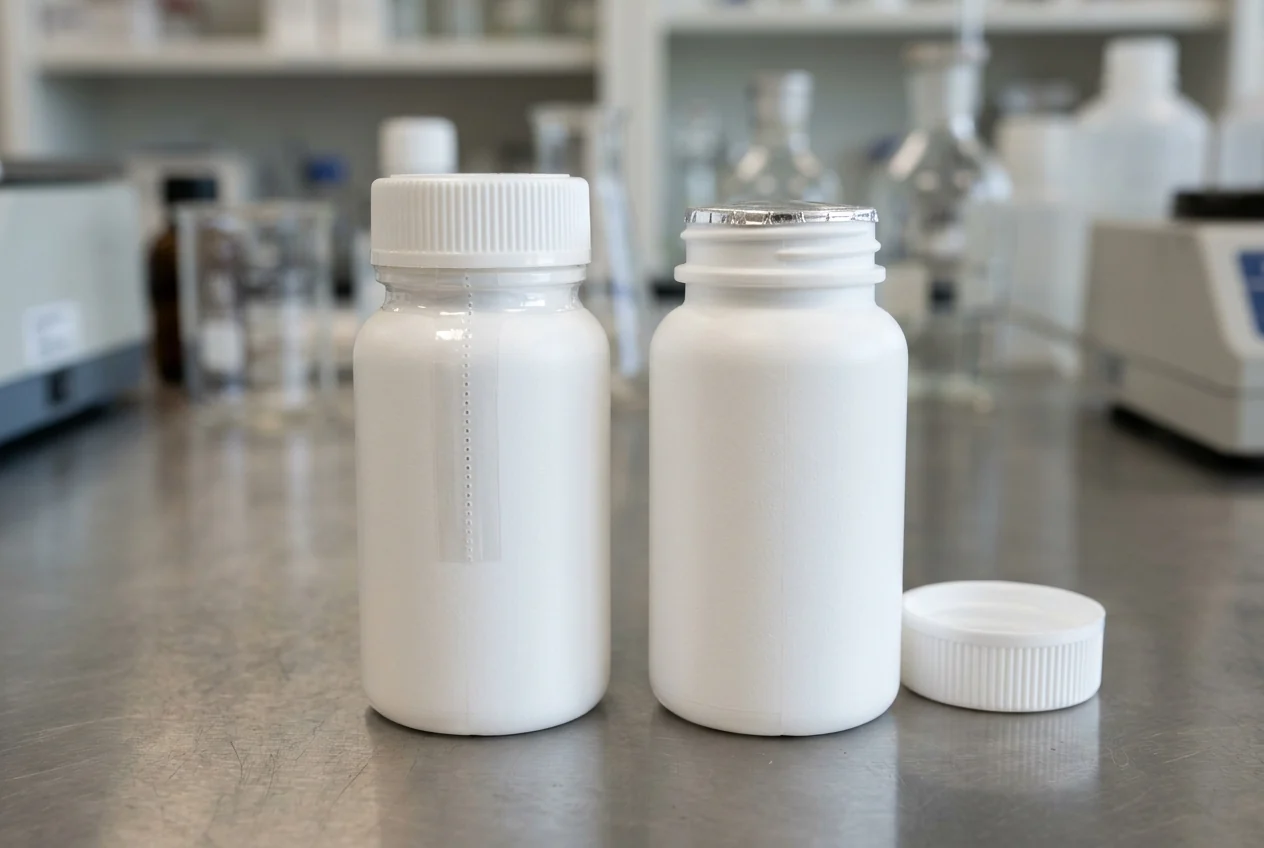
PDC International defines three primary perforation types on shrink bands and sleeves—Full Vertical, Horizontal and Partial Vertical, and Venting (typically one or two holes per side to let trapped air escape)—and warns that perforations must lay against the side of the container rather than bridging over air gaps, or they will ‘blow out’ and separate prematurely in the shrink tunnel.
Among the four common shrink sleeve materials, PVC shrinks at 60–80 °C (with some applications running up to 100–113 °C), PETG operates at 140–180 °C (284–356 °F) and achieves shrink rates up to 78%, OPS (Oriented Polystyrene) delivers higher yield and more controlled shrink rates, and corn-derived bio-based PLA (Polylactic Acid) achieves greater than 70% shrink at 80–100 °C.
In shrink tunnel operations, the four primary sleeve materials use film gauges between 40 and 70 and achieve maximum shrink ratios of up to 64% for PVC (initiating at 122–140 °F), up to 78% for PETG (initiating at 158–176 °F), up to 75% for OPS, and up to 72% for PLA; steam tunnels run at 180–200 °F (up to 70 ft/min), hot air tunnels cover 176–392 °F, and infrared tunnels operate at 350–500 °F.
For high-speed shrink sleeve and band lines (from compact applicators handling approximately 150 containers per minute to industrial systems, with supplement closures that may span 70 mm or more), converters specify tight layflat tolerances of typically ±0.5 mm and consistent cut lengths within ±1 mm, while barcodes, QR codes, and small text are placed in straight-walled low-distortion zones when shrink rates exceed 50%.
Axon’s ZPT mid-speed shrink sleeve applicator introduces rolling perforation wheel technology and is designed for speeds up to 300 containers per minute to run tamper bands, full-body sleeves, partial sleeves, and 2-, 3-, 4-, and 6-pack multipack bundles on one system.
The Axon EZ-130HS tamper-evident neck bander with ThermoFlow shrink tunnel accommodates film widths of up to 130 mm and film thicknesses of 70 microns.
Distinguish neck bands from container mouth inner seals
Under FDA CPG Sec. 450.500, container mouth inner seals applied by heat induction to plastic containers appear to offer a higher degree of tamper-resistance than those that depend on an adhesive to create the bond, whereas polystyrene foam container mouth seals applied with pressure-sensitive adhesive are no longer considered effective because they can be removed and reapplied in their original state.
A shrink band around a bottle cap shows that the cap area appears unopened, but it does not automatically prove the bottle mouth is sealed and does not replace an inner seal when moisture protection, leakage control, or stronger product barrier is needed; likewise, tamper-evident labels, shrink bands, and carton seals should not block the batch number, expiry date, barcode, serialization code, dosage instructions, or required warnings.
Compare full-carton film overwrap with box shrink wrapping
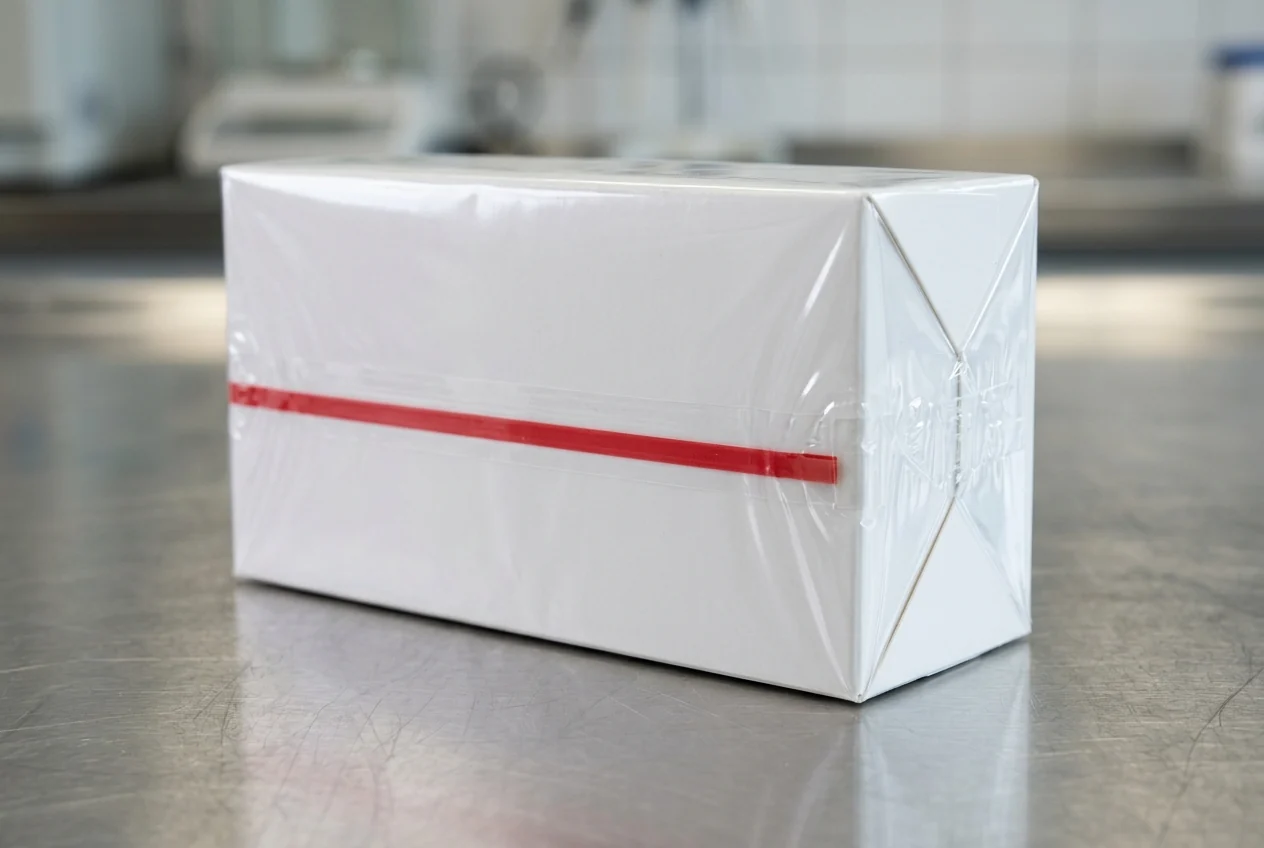
In box overwrapping comparisons, manual cellophane sheet wrappers (CW-115 / ACW-88) run at 5–10 boxes/min (1.5 kW, 220V, no compressor, film cost ~$0.02–$0.04/m, handling boxes up to 115mm x 400mm without mold changes), while semi-automatic BOPP roll overwrappers (CW-88A) run at 5–15 boxes/min (1.5 kW, 220V, no compressor, film cost ~$0.03–$0.06/m, adjustable within 100x100x30 mm limits, paired with anti-counterfeiting tear tape).
Automatic rotary BOPP overwrappers (CW-230) run at 10–120 boxes/min (7,200 units/hour) using BOPP heat-sealing roll film (~$0.025–$0.05/m) and custom molds for 1–2 fixed box sizes with six-side ironing, drawing 4.0 kW at 220V and requiring a 0.4–0.8 MPa pneumatic system fed by a 3–5 HP air compressor (adding ~$300–$800 in hardware cost and 1.5–2.5 kW in electricity).
For film transport, folding sequence, and sealing checks around cartons, see our pharmaceutical overwrapping guide.
Protect serialization barcodes and statutory text
Under EU Delegated Regulation Articles 4 and 5, the unique identifier includes a product code (less than 50 characters) and a randomized serial number (maximum 20 characters, guessing probability lower than one in ten thousand) encoded in an ISO/IEC 16022:2006 Data Matrix ECC200 barcode printed on a smooth, uniform, low-reflecting surface.
Under EU Delegated Regulation Articles 6 and 7, the two-dimensional Data Matrix barcode requires a print quality rated at least 1.5 in accordance with ISO/IEC 15415:2011, and human-readable data elements shall be printed adjacent to the barcode unless the sum of the two longest dimensions of the packaging equals or is less than 10 centimetres.
Under the UK Windsor Framework and MHRA secondary packaging rules, pharmaceutical cartons must carry clear labelling (name, expiry, batch number), tamper-evident features against unauthorized access, serialization codes for track and trace under European Falsified Medicines Directive FMD (2011 62), and a legible ‘UK Only’ label in at least 7-point font.
Align seal placement and camera grading windows with our pharmaceutical serialization and aggregation guide.
Prepare the tamper-evident packaging qualification review
Use the following questions to organize your packaging and line trial review:
- Which target markets and regulatory frameworks govern the retail or prescription pack?
- Does the closure rely on paperboard fiber tear, film destruction, a void message, a neck-ring shrink band, or a full-carton film overwrap?
- How does the carton varnish or bottle neck-ring geometry interact with the selected adhesive or shrink polymer?
- What storage and application temperatures occur across dispensing, cold-chain transport, and deep-freeze holding?
- How are label presence, wrap-over fold completion, perforation placement, and reject verification checked on the packaging line?
- Are serialization barcodes, human-readable data elements, and tactile markings kept clear of the tamper-evident feature before and after opening?
Carry the confirmed parameters into our packaging equipment requirements checklist and review related line topics in pharmaceutical packaging.
Sources
- U.S. Government Publishing Office and Food and Drug Administration — Tamper-Evident Packaging Requirements for Over-the-Counter Human Drug Products
- U.S. Food and Drug Administration — Tamper-Resistant Packaging Requirements for Certain Over-the-Counter Human Drug Products
- U.S. Food and Drug Administration — Control and Accountability of Labeling Associated with Tamper-Resistant Packaging of Over-the-Counter Drug Products
- International Organization for Standardization — Packaging Tamper Verification Features for Medicinal Product Packaging
- European Union — Technical Specifications of the Unique Identifier for Medicinal Products
- ECA Academy — New International Standard for Tamper-Evident Packaging
- Avery Dennison — Tamper-Evident Labelling Solutions for Pharmaceutical Brand Protection
- Avery Dennison — Technical Marketing Bulletin on Fasson Tamper-Evident Polyesters
- Avery Dennison — North America Security Solutions Product Overview
- Avery Dennison — Select Solutions Tamper-Evident Portfolio
- Avery Dennison — Security Labelling Solutions Guide Europe
- UPM Raflatac — Pharmaclear Polypropylene Seal Technical Release and Pharmaceutical Regulatory Compliance
- Schreiner MediPharm — First Opening Indication, Deep-Freeze Seal, and Cut-Through Indicator for Pharmaceutical Folding Boxes
- Faller Packaging — Tamper-Evident Fibre-Based Recyclable Labels for Pharmaceutical Cartons
- TamperTech — Global Guide to Pharmaceutical Packaging Security Compliance
- HERMA — Tamper-Evident Folding-Box Labeler Technical Specification
- Serpa Packaging Solutions — Tamper-Evident Labeler Technical Specification
- PDC International — Perforations in Tamper-Evident Neck Bands and Shrink Sleeve Labels
- Axon — Pharmaceutical and Nutraceutical Shrink Sleeve and Tamper-Evident Banding Systems
- Wolf-Packing Machine Company — Shrink Sleeve Labels and Shrink Tunnel Technology Guide
- CECLE Machine — Box Overwrapping Film and Shrink Wrapping Comparison
- Rich Packing — Tamper-Evident Packaging Types in Pharmaceuticals
- Automate UK — Secondary Packaging Requirements for Pharmaceuticals
- CCL Healthcare — Tamper-Evident Shrink Bands for Bottles and Carton Seals