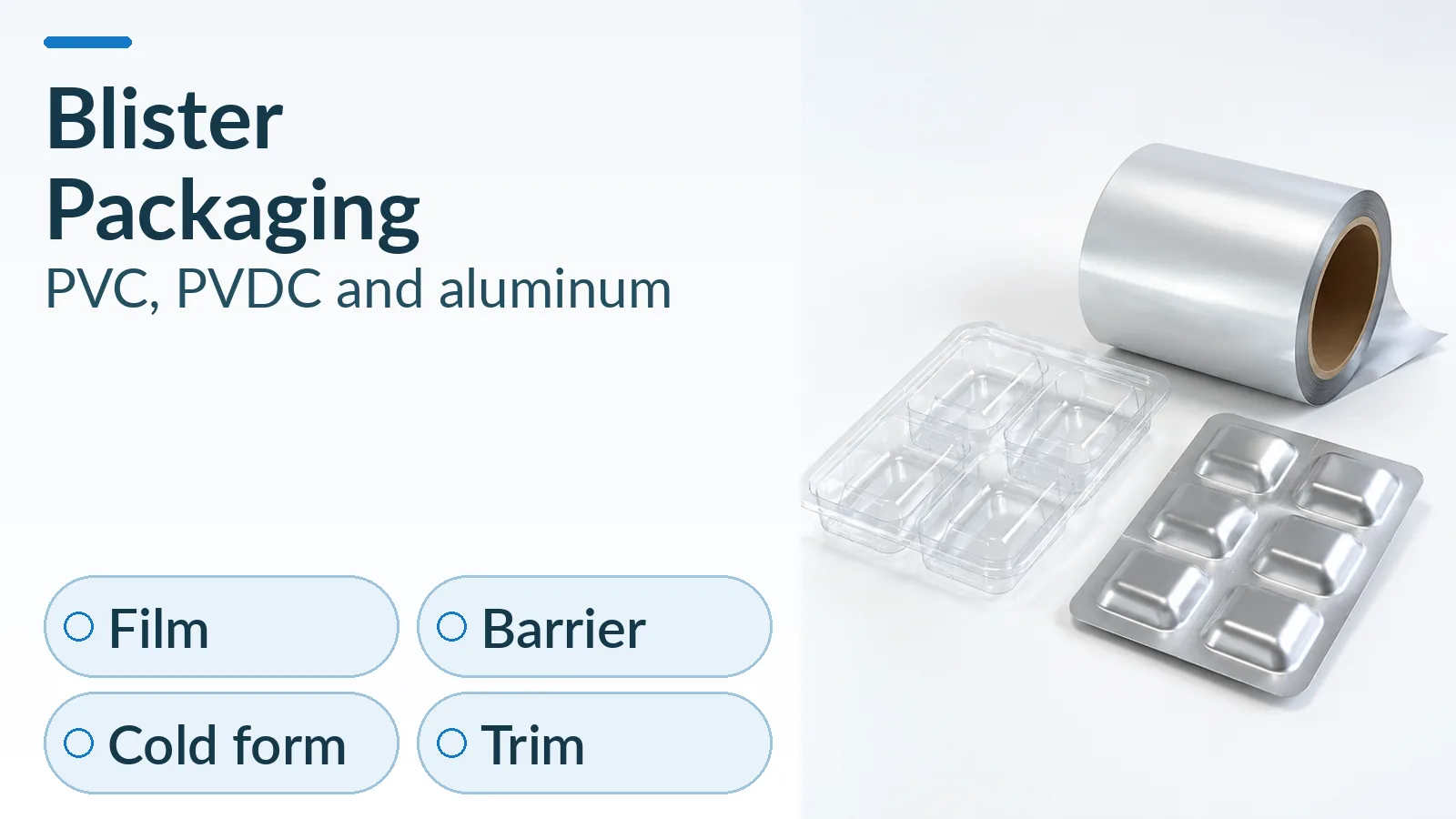
A blister packaging material chosen from its polymer name alone can waste a tooling trial and leave the product’s moisture-protection requirement unresolved. Compare PVC, PVDC-coated forming film and cold-form aluminum against the finished pack’s barrier requirement, forming behavior and seal compatibility before choosing a structure.
Blister packaging material selection starts with the product’s protection requirement and the complete formed-and-sealed pack. PVC offers clear, thermoformable options for low moisture-barrier requirements; PVDC-coated film adds a barrier coating whose grade and structure matter; cold-form aluminum uses a metal-containing laminate for demanding protection. This guide separates those material families from the evidence needed to accept a particular pack. Use the comparison, moisture-budget threshold and material-use calculation to identify what must be specified or measured before a change of web becomes a production decision.
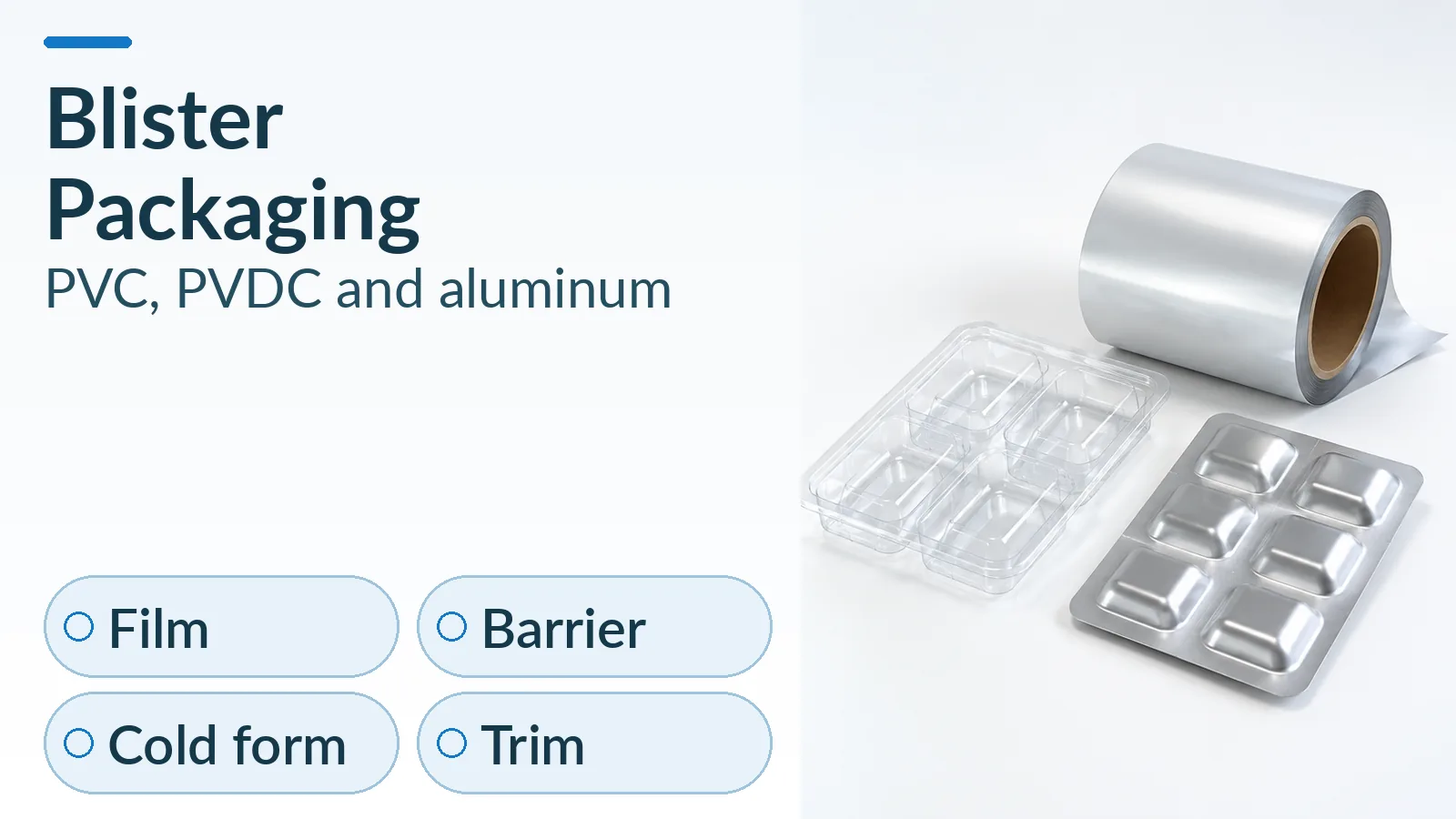
Quick specs: identify the structure and reference conditions
Compare specifications only when their material identity, units and exposure conditions match; a family name is not a permeability value.
| Input or item | Typical value or source | Why it matters |
|---|---|---|
| PVC forming film | Klöckner Pentaplast lists mono PVC options within its low moisture-barrier film portfolio | Establishes a candidate family, not a product-specific shelf life |
| PVDC-coated forming film | Klöckner Pentaplast describes different coating weights and structures with mid-to-high moisture and oxygen barrier | “PVDC” alone leaves the actual barrier grade unspecified |
| Cold-form laminate | Liveo Research describes PVC/aluminum/oriented polyamide; Constantia lists nylon/aluminum/polymer variants | Cold-form aluminum is a laminate, with different contact and support layers possible |
| Reference WVTR | Constantia REGULA displayed standard example: <0.001 g/(m²·day), 38°C, 90% RH | A named supplier specification under stated conditions; not a finished-pack result |
| Reference OTR | Same Constantia example: <0.005 cm³/(m²·day), 23°C, 50% RH | A separate gas-transmission specification under different conditions |
| Finished-pack acceptance | Product-specific stability and package evidence; ICH Q1A(R2), section 2.2.4 | Material data alone do not establish suitability of the marketed pack |
The numerical bounds above come from Constantia’s REGULA technical specifications, accessed October 2026. The public page identifies a standard example but does not establish these values as measurements of a particular formed, filled and sealed card. Comparable PVC and PVDC transmission numbers remain unspecified here.
Compare the forming web, lidding and seal together
Select a complete material structure and compatible lid, then examine where the proposed pack could lose protection.
Klöckner Pentaplast’s mono-film description supports PVC’s clarity and thermoformability in low moisture-barrier applications. Its PVDC-coated film description supports a range of barrier structures, including clear and opaque variants. A transparent grade therefore does not establish a light-protection claim.
| Forming-web family | Supported distinction | What to establish for the proposed pack | Dominant Failure Mode & Prevention |
|---|---|---|---|
| PVC mono film | Clear, thermoformable candidate for low moisture-barrier requirements | Exact grade, formed geometry, compatible lid and product stability | Moisture ingress exceeds the product’s allowance: compare the actual sealed pack with that allowance before acceptance |
| PVDC-coated film | Barrier coating with grade-dependent coat weight and structure | Base film, coating specification, formed-pocket performance and seal combination | Assuming all coated grades are interchangeable: qualify the specified structure and pocket rather than transferring another grade’s result |
| Cold-form aluminum laminate | Metal-containing structure for moisture, oxygen and light protection | Laminate construction, draw limits, formed-web integrity and seal performance | A pinhole or failed seal defeats the intended barrier: assess the formed web and seal separately |
The failure column is an engineering check for each candidate, not a measured ranking of defect frequency. Constantia specifically describes optical pinhole inspection of formed blisters; passing that check does not by itself prove seal integrity.
“Alu” also needs a location in the specification. Aluminum in a lidding foil does not identify the forming web beneath it. Liveo’s AluBa description identifies a PVC/aluminum/oriented-polyamide cold-form construction; Constantia describes other polymer options. Record the actual layers rather than assuming every aluminum-containing blister has the same architecture.
Use a physical threshold for the moisture budget
Reject a candidate that exceeds the product’s permitted moisture gain under the specified exposure; changing a material name does not resolve a failed budget.
Rules-of-Thumb: If moisture-budget margin < 0 mg per cavity under the same specified temperature, humidity and storage interval → choose a higher-barrier candidate for qualification, because measured moisture gain has exceeded the product’s available allowance. Accept a PVDC-coated or cold-form candidate only after its own complete-pack evidence meets that allowance.
Here, moisture-budget margin means permitted added moisture minus measured added moisture, expressed on the same per-cavity basis. The zero boundary is an engineering pass/fail relationship, not a published universal drug limit. The product-specific allowance and storage interval must come from the product’s development evidence; no default allowance is assumed.
If the problem is a leaking seal, address that defect before concluding that the forming film needs a higher barrier. ICH Q1A(R2), section 2.2.4, places stability testing in the container-closure system proposed for marketing, including appropriate secondary packaging and labeling. A film-family comparison cannot replace that configuration-specific evidence.
Calculate forming-web use per accepted card
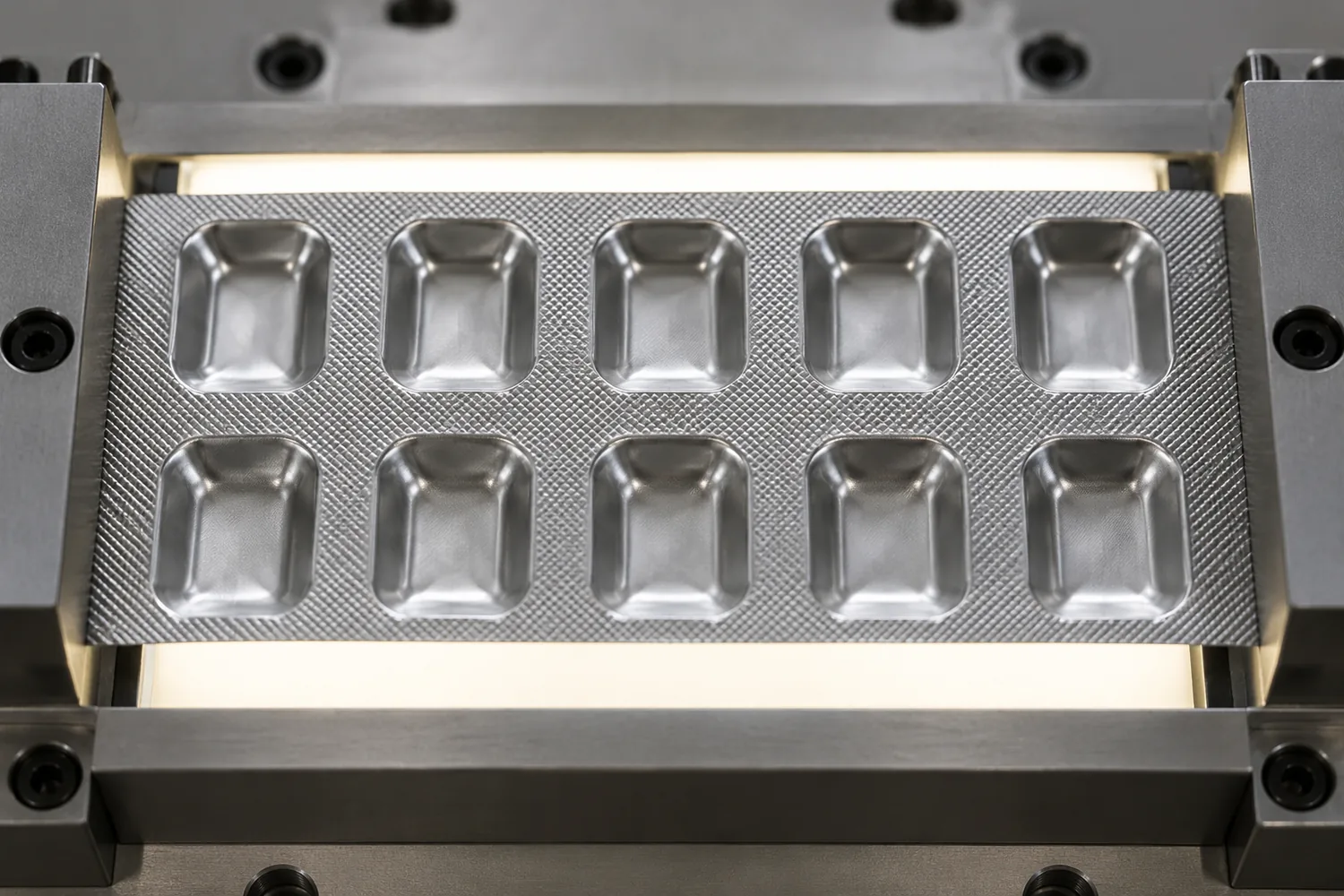
Account for web consumption using accepted cards, so reject losses remain visible in the material comparison.
For an indexed layout, define W as forming-web width in meters, P as index pitch in meters, n as cards produced per index, and Y as the accepted-card fraction for that run segment:
Forming-web area per accepted card = W × P / (n × Y).
Worked example — all inputs are assumptions: W = 0.120 m; P = 0.100 m; n = 1 card per index; Y = 0.96. Assume uniform allocation of the entire forming web to those cards, excluding start-up material and the separate lidding web. Then 0.120 × 0.100 / (1 × 0.96) = 0.0125 m² per accepted card.
This geometric example includes the material between pockets and cards. It establishes neither an actual yield nor an advantage for PVC, PVDC or aluminum. To compare real proposals, substitute each approved layout and observed accepted fraction, then add start-up scrap and lidding consumption separately.
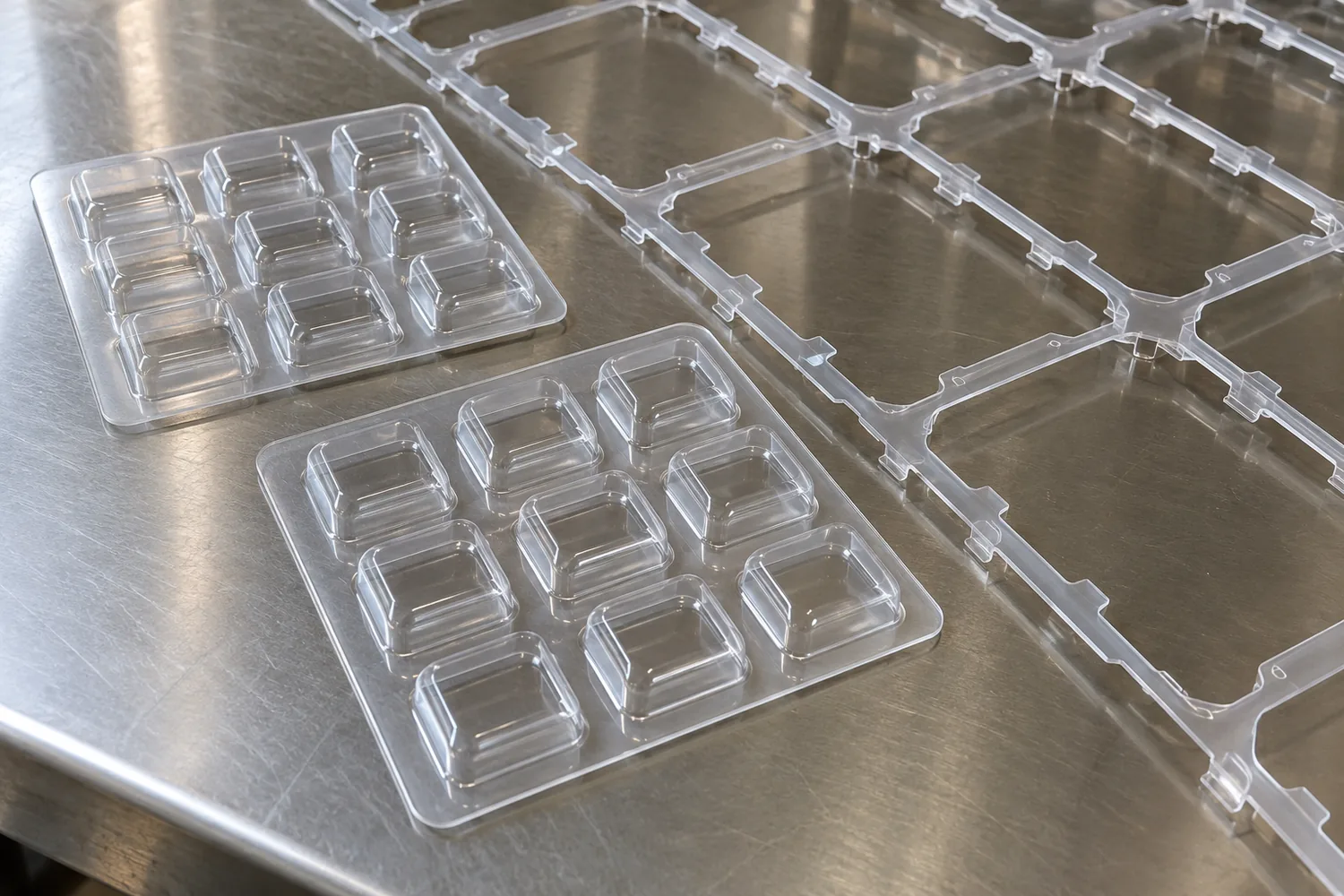
Follow the material through its lifecycle
Track forming scrap, rejected filled cards, changeover hours and downstream handling alongside the barrier result.
A useful trial record separates unused start-up web from rejects that already contain product. Record roll changes, cleaning and tooling time, and energy consumption where measured; do not assign universal savings to a material family. If the card footprint or stiffness changes, check the downstream pack configuration as well.
The blister-versus-bottle comparison addresses the earlier pack-format decision. The guide to primary, secondary and tertiary packaging helps identify which layer provides each protective function. Keep those functions explicit when reviewing a material change within the pharmaceutical packaging section.
Method and sources
This comparison uses the linked original film-supplier descriptions and technical specifications, plus ICH Q1A(R2), section 2.2.4, for the final-pack stability context. Supplier transmission bounds retain their named structure and stated conditions. Failure checks and the zero-margin rule are engineering deductions; the material-use example labels every input as an assumption. No common numerical barrier ranking or shelf-life prediction is inferred from these sources.
Updated October 2026.