

Packaging specifications are easier to compare when the same term identifies the same component or activity in every drawing, quotation and test record. This glossary connects common terms with the decision or check they describe.
Packaging layers and formats
| Term | Meaning | Practical distinction |
|---|---|---|
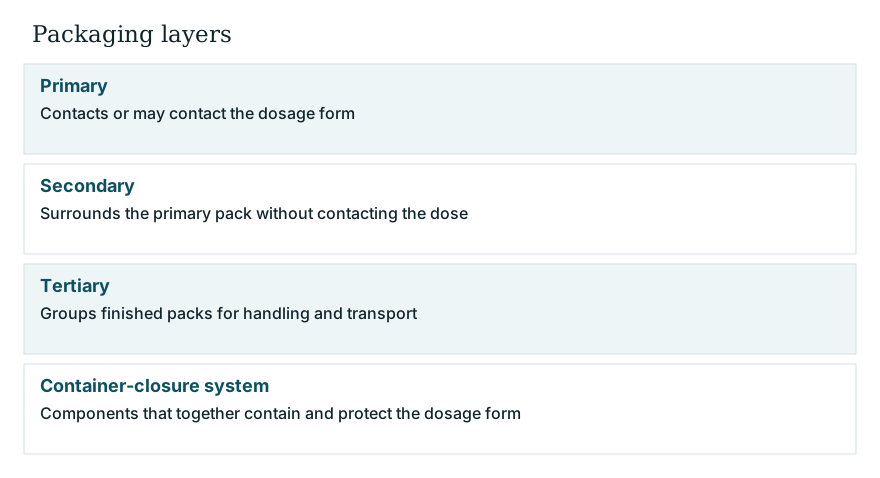
| Primary packaging component | Contacts or may contact the dosage form | Material and closure suitability affect the medicine directly |
| Secondary packaging component | Does not contact the dosage form | May provide identification, handling or additional protection |
| Tertiary packaging | Groups packs for transport and handling | Includes shipping cases and pallet arrangements |
| Container-closure system | Components that together contain and protect the dosage form | Can include a secondary protective component |
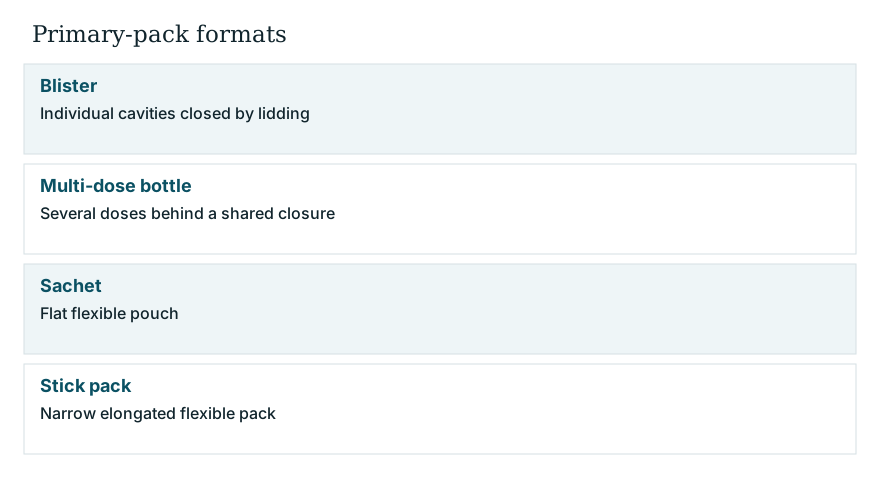
| Blister | A pack with separate cavities closed by lidding | Assess cavity, lidding and seal together |
| Multi-dose bottle | A container holding several doses behind a shared closure | Opening and reclosing are part of its use |
| Sachet | A flat flexible pouch | Define fill, perimeter seals and opening |
| Stick pack | A narrow elongated flexible pack | Define fill path, longitudinal seal and end seals |
FDA’s container-closure guidance, section II.A, defines primary and secondary components and the complete container-closure system. The packaging-layer guide applies those distinctions to specifications and defect reports.
Packaging operations and qualification
Cartoning places the primary pack and any required leaflet into a carton. Overwrapping adds film around the carton or a group of cartons. Line clearance checks that the area and materials are ready for the next packaging operation. Reject handling removes a failed pack from the accepted product flow and accounts for it.
A URS, or user requirements specification, describes the functions and criteria required by the user. DQ is design qualification. IQ, OQ and PQ refer to installation, operational and performance qualification. EU GMP Annex 15 describes these stages and their relationship to the equipment lifecycle. The URS checklist helps organise requirements and acceptance evidence.
Health-system and supply terms
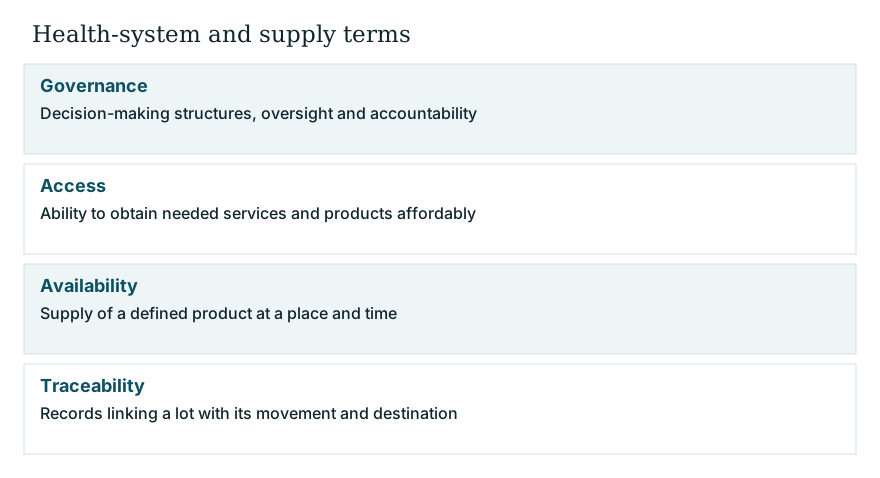
Governance concerns the structures, decisions and accountability through which a health system operates. Access concerns whether people can obtain the services and products they need, including affordability. Availability concerns whether the required product can be supplied in the relevant place and period. A supply investigation should specify that place, period and product before comparing results.
Use systems thinking for governance, access to medicines for coverage indicators and medicine supply chains for operational handoffs.