

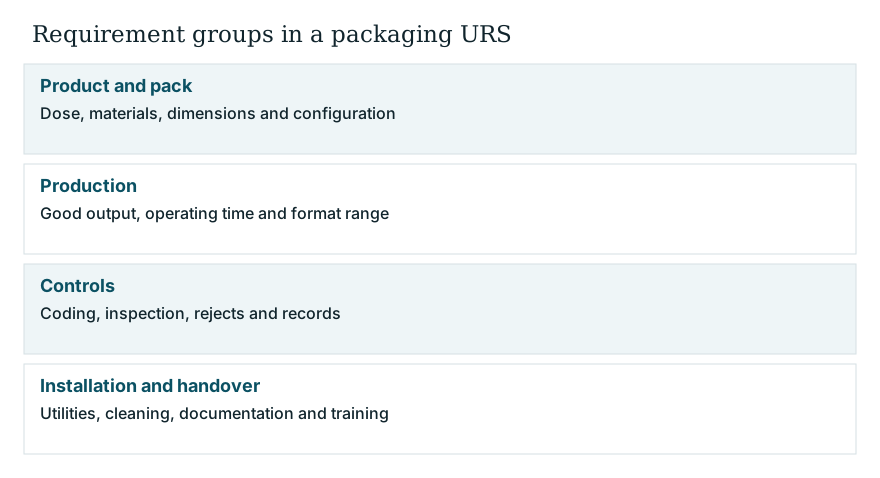
A user requirements specification (URS) records what a packaging system must do and the criteria used to assess it. EU GMP Annex 15, section 3.2, uses the URS as a reference through the validation lifecycle. Assign each requirement an identifier so it can be traced through design review and testing.
Requirements and acceptance checks
| Requirement | Information and units | Suggested acceptance evidence |
|---|---|---|
| Product | Dosage form, fill mass or volume, count per pack | Product specification and agreed trial materials |
| Primary pack | Material, dimensions in mm, closure configuration | Approved drawings and packaging assessment |
| Carton and leaflet | Contents, drawing and artwork revisions | Presence, identity and insertion checks |
| Output | Good packs/min for each format; available production time | Agreed timed run with rejects and stops recorded |
| Coding | Required content, position and readability | Correct-code and unreadable-code challenges |
| Reject handling | Detection, removal, confirmation and fault response | Tracked challenge packs and reconciliation |
| Cleaning and changeover | Procedure, access and format-change scope | Demonstration against the agreed procedure |
| Interfaces and utilities | Transfer conditions and site supply requirements | Interface tests and installation checks |
| Documentation | Drawings, manuals, settings and training scope | Controlled document and handover review |
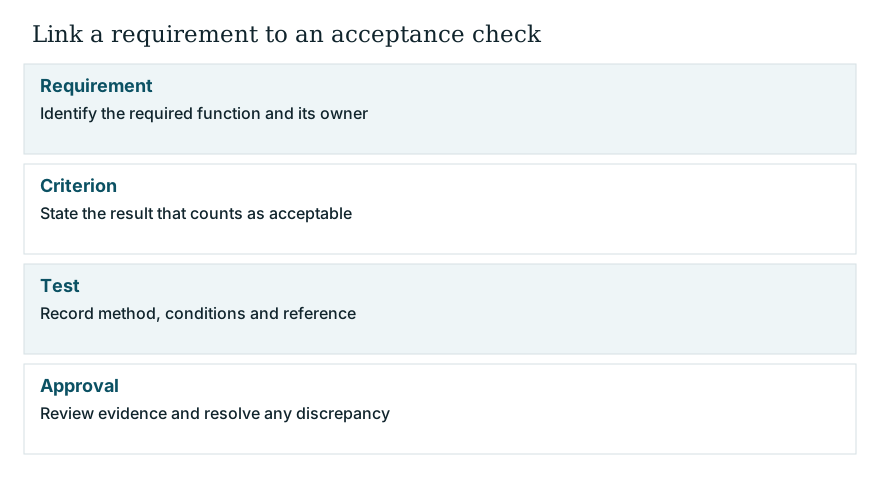
Download the URS checklist as a text file for local editing. Add the requirement owner, acceptance criterion, test reference and approval status for each row.
Turn a requirement into a test
“Reject a missing leaflet” needs more detail before acceptance. State how the test pack is introduced, which detection result is expected, where the pack must go and what happens if removal fails. Record the challenge-pack count so those packs are accounted for at the end of the test.
Define output in finished good packs and specify the product, format and run duration. Use the line-selection calculation to connect that rate to the production schedule. Keep cycles, lanes and completed packs distinct for a sachet or stick-pack system.
Review the specification across the project
Operations should review handling and changeover needs; engineering should review interfaces and utilities; quality should review product risks and acceptance evidence. Record changes to requirements and assess their effect on drawings, tests and approvals.
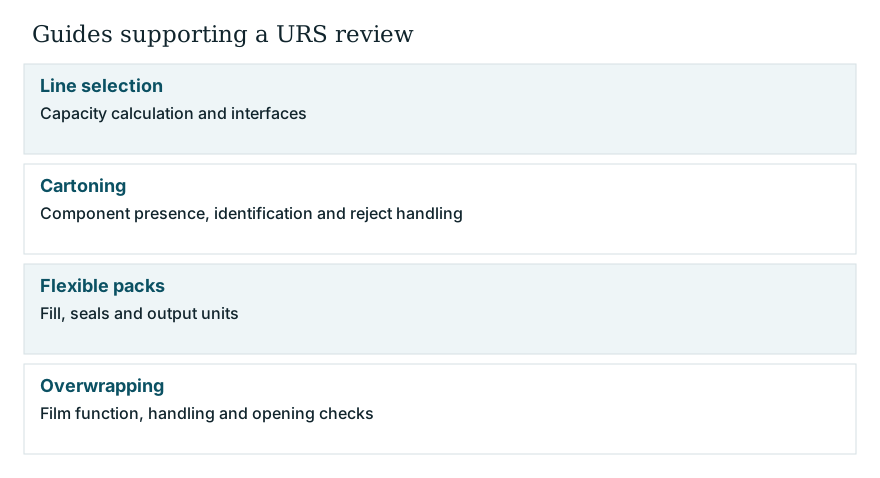
For US drug manufacture, check the relevant container and closure provisions in 21 CFR 211.94 and packaging controls in 21 CFR 211.130. Use the cartoning guide for component and reject checks, cartoning machine leaflet and tuck checks for inline leaflet-folder, pharmacode and flap-closure specifications, and the glossary for terminology.