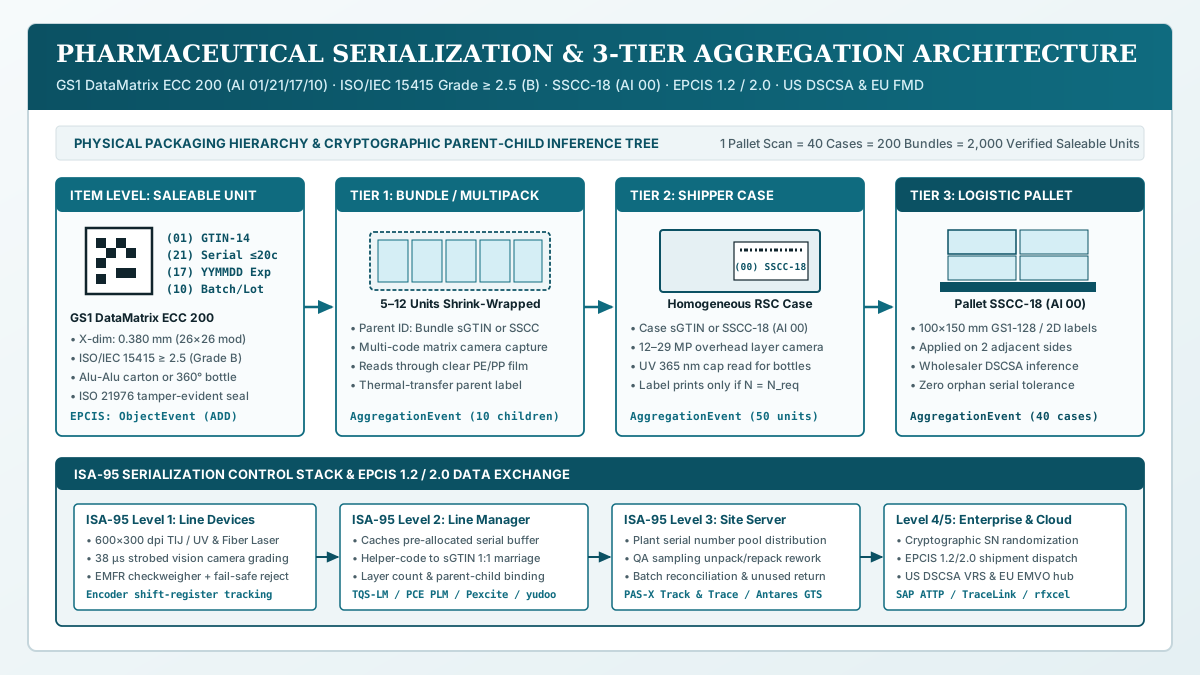
Pharmaceutical serialization is the unit-level assignment, printing, optical grading, and commissioning of a unique GS1 DataMatrix ECC 200 identifier (sGTIN, batch/lot, and expiration date) on every smallest saleable medicine pack, while multi-level aggregation binds those child serials into parent bundles, shipping cases, and pallet SSCC-18 labels. If a single unit barcode degrades below ISO/IEC 15415 Grade C (1.5) or an unrecorded QA sample breaks the parent-child EPCIS hierarchy, downstream wholesale receiving docks cannot infer the contents of sealed cases—triggering immediate DSCSA quarantine holds, batch rejections, and dispensing delays across the medicine supply chain and pharmaceutical supply chain.
Addressing the release and receipt bottlenecks mapped in packaging and medicine availability, this engineering guide specifies the barcode syntax, ISO/IEC 15415 optical grading budgets, three-tier aggregation hardware, ISA-95 data architecture, and line controls required across both secondary carton lines for alu alu blister packaging and high-speed bottle filling line installations.
Three-tier serialization, aggregation levels, and OEM equipment benchmarks
Physical medicine packaging is divided into primary, secondary and tertiary packaging layers. In a track-and-trace architecture, unit-level serialization occurs on the smallest saleable pack (typically the secondary folding carton enclosing blister cards or vials, or the primary multi-dose bottle on a tablet/liquid line), followed by up to three parent-child aggregation tiers:
| Serialization / Aggregation Tier | Physical Packaging Layer | GS1 Identifier & Application Identifiers (AIs) | EPCIS 1.2 / 2.0 Event & Action | Inline Optical Verification & Line Control |
|---|---|---|---|---|
| Item Level: Saleable Unit Serialization | Secondary folding carton (holding blisters/vials/sachets) or primary multi-dose bottle | sGTIN in GS1 DataMatrix ECC 200: AI (01) GTIN-14 + AI (21) Serial + AI (17) Expiry + AI (10) Batch/Lot |
ObjectEvent (action: ADD, bizStep: commissioning, disposition: active) |
100% inline camera grading (ISO/IEC 15415 >= 2.5 / B) + OCV of human-readable text + shift-register tracking to fail-safe reject bin |
| Aggregation Level 1: Intermediate Bundle / Multipack | Shrink-wrapped, kraft-overwrapped, or banded group of 5, 10, or 12 unit cartons (or bottle tray) |
Bundle sGTIN (AI 01 + AI 21) or intermediate SSCC (AI 00) on thermal-transfer label |
AggregationEvent (action: ADD, parentID: Bundle ID, childEPCs: [5–12 unit sGTINs]) |
Multi-code overhead/side matrix camera reads all child DataMatrix codes through clear shrink film before printing parent bundle label |
| Aggregation Level 2: Homogeneous Shipper Case | Corrugated RSC shipping case holding layers of bundles, cartons, or bottles (e.g., 40–50 cartons or 24–48 bottles) |
Case sGTIN (AI 01 indicator digit + AI 21) or Case SSCC-18 (AI 00) in GS1-128 and/or 2D DataMatrix |
AggregationEvent (action: ADD, parentID: Case SSCC/sGTIN, childEPCs: [Bundle or Unit IDs]) |
12–29 MP autofocus overhead layer camera (or 365 nm UV cap camera for bottles) verifies 100% layer count (N_read = N_expected) before case label print |
| Aggregation Level 3: Logistic Pallet | Stretch-wrapped warehouse/export pallet carrying 20 to 60 homogeneous shipping cases |
Pallet SSCC-18 (AI 00) printed on 100 × 150 mm labels on two adjacent pallet sides |
AggregationEvent (action: ADD, parentID: Pallet SSCC-18, childEPCs: [Case SSCCs]) |
Robotic palletizer scanner, 360° portal, or industrial ring/handheld scanner verifies every case SSCC before generating master pallet SSCC |
OEM serialization and aggregation platform comparison
Configuring an end-to-end packaging line requires matching the mechanical transport pitch and vision capture geometry of the serialization and aggregation stations to the upstream cartoning machine or bottle labeler:
| OEM & Platform Family | Representative Models Across L1–L3 Tiers | Packaging Formats & Aggregation Levels Supported | Rated Line Speed | Key Mechanical, Optical & Software Engineering Features |
|---|---|---|---|---|
WIPOTEC-OCS TQS Series |
TQS-HC-A, TQS-SP, TQS-BP, TQS-CP | Unit cartons, bottles, tamper-evident sealing, bundle (TQS-BP) & case (TQS-CP) aggregation |
TQS-HC-A: 300–600 cpm; TQS-BP: 30–75 bundles/min |
Monoblock frame combining dual top/bottom belt carton clamping, TIJ/laser coding, optical grading, vignette/TE labeler, and Electro-Magnetic Force Restoration (EMFR) checkweigher with separate coding vs. weight reject bins; unified TQS-LM / ConfigureFast L2 software |
| Mettler-Toledo PCE | T2620, T60 Integrated 360, T2650, T2660 MAS | Unit cartons (T2620), 360° round bottles (T60), inline cases (T2650) & manual rework (T2660) |
T2620: up to 400 cpm; T60: up to 300+ bottles/min |
High-stability carton transport up to 150/250 mm width; 6-camera 360° radial bottle imaging with UV cap/bottom helper-code marriage on T60; mobile T2660 Manual Aggregation Station supporting up to 3 printers for palletizing and QA sample rework under PCE Line Manager (PLM) |
| Uhlmann Pac-Systeme | S 500 (USP), Aggregation Platform (UAP), Terminal T1, EC 12 + Pexcite | Blister cartons, bottles, bundle/case packing (EC 12) & L1–L3 software (Pexcite) |
S 500: 300–400 cpm or 200+ bpm; EC 12: 12 cases/min |
Native mechanical and recipe synchronization with upstream Uhlmann blister machines (B 1240 / B 1440 / B 1660) and cartoners (C 2155 / C 2205 / C 2305 / C 2504); VisioRead camera grading; SmartControl HMI; mobile T1 warehouse rework terminal |
| Syntegon / Rotzinger PharmaPack | CPS 1400 / CPS 1400 W, CPS 1900 WTE, CPA Case Aggregator |
High-speed secondary cartons, dynamic checkweighing, ISO 21976 ATD & case aggregation | CPS 1400 / 1900: up to 350–400 cpm |
Modular inline print-verify-weigh-seal architecture with dual-flap TIJ/laser coding, integrated dynamic checkweigher, wrap-around tamper-evident security labeling, and autofocus overhead camera layer capture on CPA case stations |
| Marchesini Group (Neri) + SEA Vision | Neri BL A400 / BL A420 & SEA Vision Track360 / yudoo |
Folding cartons (BL A400) & cylindrical bottle 360° serialization (Track360) |
BL A400: up to 400 cpm; Track360: 250–300 bpm |
Positive toothed-belt carton transport on BL A400 eliminating belt slip during TIJ firing (minimizing Axial Non-Uniformity); Track360 multi-camera lateral array reading unoriented round bottle labels paired with overhead 365 nm UV helper-code verification |
| Antares Vision Group | Print & Check, Matrix / Bottle Tracking 360°, CTS, ATS (L2) & GTS / rfxcel (L3/L4) |
Full-stack L1 carton/bottle hardware through L4/L5 enterprise cloud | Cartons: up to 400 cpm; Bottles: up to 300+ bpm |
End-to-end hardware and software stack combining 360° cylindrical vision reconstruction, UV helper-code marriage for high-speed bottle filling lines, layer-by-layer case aggregation, and native rfxcel / GTS EPCIS 1.2 / 2.0 regulatory reporting |
Unit-level GS1 DataMatrix ECC 200 syntax and ISO/IEC 15415 grading
Both the US FDA Drug Supply Chain Security Act (DSCSA, FD&C Act Section 582) and EU Falsified Medicines Directive (FMD) Commission Delegated Regulation (EU) 2016/161 mandate that every smallest saleable medicine package carry a four-element Unique Identifier (UI) / Product Identifier encoded inside a two-dimensional GS1 DataMatrix ECC 200 symbol and printed in adjacent human-readable text:
- Product Code / GTIN-14 — Application Identifier
AI (01): Fixed14-digitnumeric field (N2+N14) embedding the US National Drug Code (NDC) or EU National Trade Item Number (NTIN), terminated by a Modulo-10 check digit. BecauseAI (01)has a predefined fixed length in the GS1 specification, it never requires a trailing Group Separator character. - Expiration Date — Application Identifier
AI (17): Fixed6-digitnumeric field (N2+N6) formatted asYYMMDD(whereDD = 00designates the last calendar day of monthMM). BecauseAI (17)is also fixed-length, it requires no trailing Group Separator. - Batch or Lot Number — Application Identifier
AI (10): Variable-length alphanumeric string (N2+X..20, up to20characters from the GS1-82 invariant character set). UnlessAI (10)is placed at the very end of the encoded string, it must be terminated by a non-printableASCII 29(Hex 1D) Group Separator (<GS>) codeword so the scanner knows where the lot number ends and the next Application Identifier begins. - Unique Serial Number — Application Identifier
AI (21): Variable-length alphanumeric string (N2+X..20, up to20characters). Under EU 2016/161 Article 4(b), serial numbers must be randomized with a probability of guessing lower than1 in 10,000(< 0.01%) and a uniqueness persistence of at least5 yearsor1 yearpast expiration (whichever is longer). Under EU FMD, member states may also mandate a fifth element—AI (710–714)National Healthcare Reimbursement Number (NHRN)—alongside a physical Anti-Tampering Device (ATD) conforming toISO 21976:2018.
Canonical GS1 codeword ordering to minimize matrix size
A frequent commissioning fault during packaging-line setup is placing both variable-length fields (AI 21 and AI 10) ahead of fixed-length AI (17), which forces the printer to encode two separate <GS> delimiters and often pushes the DataMatrix symbol from a 22 × 22 or 24 × 24 grid into a larger 26 × 26 or 32 × 32 grid.
The canonical GS1 healthcare encoding sequence places the leading Function 1 Symbol Character (<FNC1>, ASCII 232) first, followed by fixed-length AI (01) and AI (17), then variable-length AI (10) plus a single <GS> (ASCII 29), and finally variable-length AI (21) at the end of the symbol:
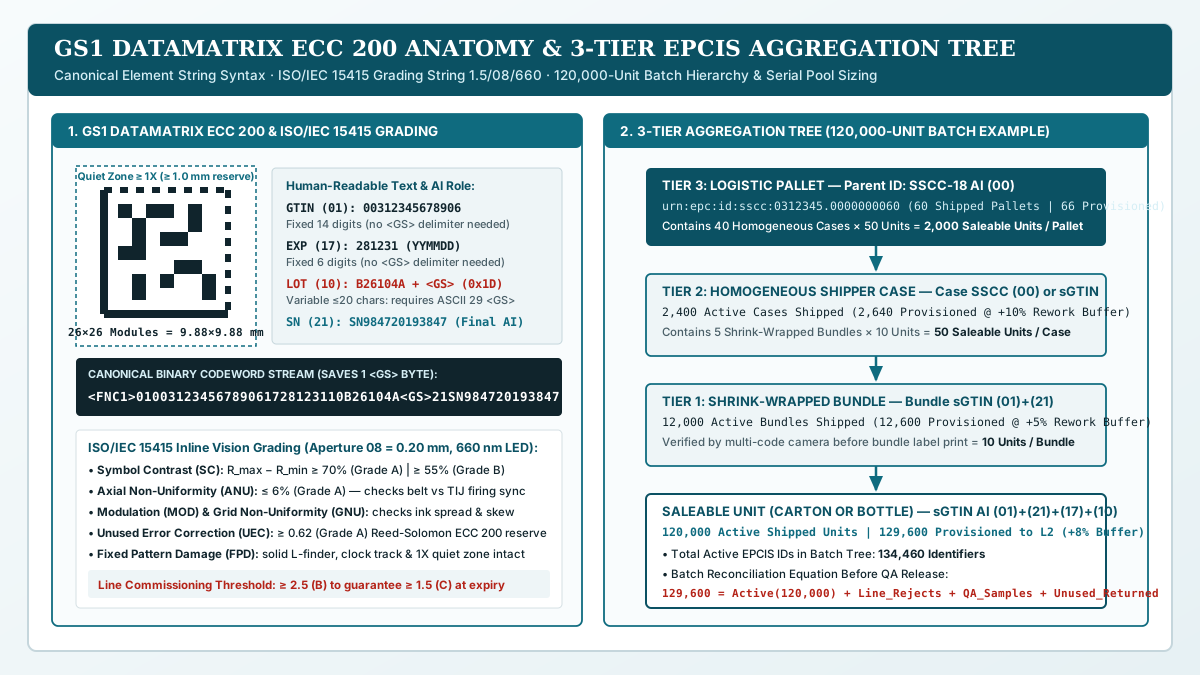
<FNC1> 01 00312345678906 17 281231 10 B26104A <GS> 21 SN984720193847
Placing AI (21) last eliminates the final <GS> character before the Reed-Solomon ECC 200 padding and error-correction bytes (computed over the Galois field GF(2^8)), allowing the symbol to survive up to 20–30% surface damage while fitting inside a compact 24 × 24 or 26 × 26 square matrix (or a 16 × 36 / 16 × 48 Data Matrix Rectangular Extension DMRE on narrow carton flaps).
ISO/IEC 15415 inline vision grading and the commissioning buffer
Per GS1 General Specifications Symbol Specification Table 6, healthcare GS1 DataMatrix symbols printed on secondary cartons or primary labels specify an X-dimension (single module width) between 0.254 mm (10.0 mil minimum) and 0.495 mm (19.5 mil maximum), with a target nominal X-dimension of 0.380 mm (15.0 mil) and an unprinted white Quiet Zone of at least 1X (>= 0.380 mm, with >= 1.0 mm recommended on carton die-lines) around all four perimeter edges.
Inline smart cameras verify every printed symbol against ISO/IEC 15415 using the GS1 reference grading string 1.5/08/660—representing a minimum passing grade of 1.5 (Grade C), a synthetic measurement aperture of reference 08 (0.20 mm diameter), and 660 nm ± 10 nm red LED illumination at a 45° four-sided angle:
- Decode (
4.0Pass or0.0Fail): Applies the reference decode algorithm to locate the solid L-shaped finder bars and alternating clock track. - Symbol Contrast (
SC): Difference between maximum light background reflectance (R_max) and minimum dark ink reflectance (R_min).Grade A (4.0)requiresSC >= 70%;Grade B (3.0) >= 55%;Grade C (2.0) >= 40%. - Modulation (
MOD) & Reflectance Margin: Evaluates the uniformity of dark and light module reflectance relative to the global reflectance threshold, penalizing thermal inkjet satellite droplets, ink bleed into uncoated board fibers, or specular glare from overprint varnish. - Axial Non-Uniformity (
ANU): Measures scaling differences between the horizontal (X) transport axis and vertical (Y) printhead nozzle axis.Grade ArequiresANU <= 6%(Grade B <= 8%,Grade C <= 10%). HighANUindicates encoder wheel slippage or carton micro-slip between the serializer’s clamping belts during print firing. - Grid Non-Uniformity (
GNU): Maximum vector displacement of module centers from their ideal grid intersections (Grade A <= 0.38X), catching mechanical vibration or rotational carton skew. - Unused Error Correction (
UEC): Fraction of remaining Reed-SolomonECC 200error-correcting capacity (Grade A >= 0.62,Grade B >= 0.50,Grade C >= 0.37). - Fixed Pattern Damage (
FPD): Integrity of the left/bottom solid L-finder border, top/right alternating clock track, and surrounding1Xquiet zone.
Because the overall ISO/IEC 15415 grade equals the lowest individual parameter score (never the mean), and GS1 mandates >= 1.5 (C) at the final point of dispensing, pharmaceutical packaging lines configure inline camera ejection thresholds at >= 2.5 (B) or >= 3.0 (B+) at commissioning. Any carton grading below 2.5 (or failing Optical Character Verification OCV on the human-readable lines) is tracked by the encoder shift register into the locked coding-reject bin, with a confirmation photoeye verifying physical removal.
Worked calculation 1: GS1 DataMatrix footprint, TIJ firing frequency, and camera exposure blur budget
Consider a secondary carton serializer (such as a WIPOTEC TQS-HC-A or Mettler-Toledo T2620) running downstream of a continuous cartoner at 300 cartons/min (5.0 cartons/s) with a linear transport belt speed of v_belt = 60 m/min = 1.00 m/s = 1,000 mm/s (200 mm center-to-center pitch between 80 mm cartons). The thermal inkjet (TIJ, HP 45si cartridge) prints a 26 × 26 module GS1 DataMatrix ECC 200 at nominal X = 0.380 mm with a horizontal resolution of 300 dpi along the direction of travel:
- Physical symbol dimensions and artwork white window:
- Symbol matrix width and height:
W_sym = H_sym = 26 modules × 0.380 mm/module = 9.88 mm. - Minimum unvarnished white reserve window (including the mandatory
1X = 0.380 mmquiet zone on all four sides):W_min = 9.88 mm + 2 × 0.380 mm = 10.64 mm × 10.64 mm(or11.88 mm × 11.88 mmusing a standard1.0 mmmechanical registration margin).
- Symbol matrix width and height:
- TIJ print duration and nozzle firing frequency:
- Time required for the
9.88 mmsymbol to pass the stationary TIJ nozzle array atv_belt = 1,000 mm/s:t_print = W_sym / v_belt = 9.88 mm / 1,000 mm/s = 0.00988 s = 9.88 ms. - At
300 dpihorizontal resolution (300 dots / 25.4 mm = 11.811 dots/mm, depositing4.49ink drops across each0.380 mmmodule), the required cartridge firing frequency is:f_fire = v_belt × 11.811 dots/mm = 1,000 mm/s × 11.811 dots/mm = 11,811 Hz(11.81 kHz, well within the15–18 kHzoperating envelope of pharmaceutical TIJ cartridges). - To preserve
ISO/IEC 15415Axial Non-UniformityGrade A(ANU <= 6%), cumulative belt-to-encoder velocity error across that9.88 mswindow must not stretch or compress the symbol length by more than0.06 × 9.88 mm = ±0.59 mm.
- Time required for the
- Vision camera maximum exposure time (
t_exp_max) to prevent motion-blur modulation loss:- To prevent motion blur from degrading Modulation (
MOD) and Fixed Pattern Damage (FPD), carton travel during the camera shutter opening (Δx_blur) must not exceed10%of one module width (0.10 × X):Δx_blur_max = 0.10 × 0.380 mm = 0.038 mm(38 µm). - Dividing
Δx_blur_maxby the1,000 mm/sbelt speed yields the maximum allowable camera integration time:t_exp_max = 0.038 mm / 1,000 mm/s = 0.000038 s = 38 µs. - Operating at a
30–38 µsshutter requires high-current over-driven660 nmred LED strobe illumination synchronized directly to the line’s quadrature shaft encoder (0.05–0.10 mm/pulse).
- To prevent motion blur from degrading Modulation (
ISA-95 L1–L5 architecture and worked batch serial-pool sizing
A compliant pharmaceutical serialization and aggregation deployment separates real-time machine control from enterprise repository management across the five levels of the ISA-95 automation hierarchy:
- Level 1 (L1 — Shop-Floor Devices): Thermal inkjet (
TIJ), thermal transfer overprinter (TTO), orUV / CO2 / Fiberlaser markers; high-speedISO/IEC 15415grading cameras and layer-aggregation cameras; industrial label print-and-apply (P&A) engines (e.g., ZebraZE500 / ZE511, Sato, or Markem-Imaje); quadrature shaft encoders; and dual fail-safe reject actuators with confirmation photoeyes. - Level 2 (L2 — Line Management System / LMS): Dedicated line controller (e.g., WIPOTEC
TQS-LM, Mettler-ToledoPCE Line Manager, UhlmannPexcite, or SEA Visionyudoo) that caches pre-allocated serial numbers locally in non-volatile memory, manages real-timehelper-code <-> sGTINmarriage tables, verifies exact layer counts during case packing, and buffers events so the packaging line continues running without interruption if plant network connectivity drops. - Level 3 (L3 — Site Serialization Server): Plant-wide server (e.g., Körber
PAS-X Track & Trace, RockwellPharmaSuite, or Antares VisionGTS) that provisions serial pools to multiple L2 lines viaOPC-UAorXML, controls warehouse manual aggregation/rework stations, and enforces end-of-batch serial reconciliation before Quality Assurance batch release. - Level 4 & Level 5 (L4 Enterprise Repository & L5 Regulatory/Partner Cloud): Enterprise systems (e.g.,
SAP ATTP,TraceLink Opus, orrfxcel) that generate cryptographic serial ranges, store the masterEPCIS 1.2(XML) orEPCIS 2.0(JSON / JSON-LD) event repository, transmit outbound DSCSATransaction Information (TI)andTransaction Statement (TS)files to wholesale distributors viaAS2, respond to Verification Router Service (VRS) queries, and upload statutory product packs to the European Medicines Verification Organisation (EMVO/ nationalNMVShubs).
Worked calculation 2: 3-tier aggregation hierarchy and serial buffer sizing at 240 cartons/min
Suppose a secondary blister packaging line runs at a sustained speed of 240 cartons/min over an 8-hour (480-minute) production shift (240 × 480 = 115,200 cartons), rounded in the master batch record to a nominal batch target of N_unit = 120,000 good saleable cartons (500 minutes net run time). The packaging specification defines a three-tier aggregation hierarchy:
- Tier 1 (Bundle):
n_u = 10saleable cartons shrink-wrapped per bundle (Bundle sGTIN) - Tier 2 (Homogeneous Shipper Case):
n_b = 5bundles packed per corrugated RSC case (50saleable cartons perCase SSCC) - Tier 3 (Logistic Pallet):
n_c = 40shipping cases stacked per pallet (2,000saleable cartons perPallet SSCC-18)
- Net active identifiers in the shipped EPCIS hierarchy tree:
- Active Saleable Units (
sGTIN):N_unit = 120,000 - Active Tier 1 Bundles:
N_bundle = 120,000 / 10 = 12,000 - Active Tier 2 Shipper Cases (
Case SSCC):N_case = 12,000 / 5 = 2,400 - Active Tier 3 Pallets (
Pallet SSCC-18):N_pallet = 2,400 / 40 = 60 - Total active EPCIS identifiers shipped:
120,000 + 12,000 + 2,400 + 60 = 134,460active parent and child IDs.
- Active Saleable Units (
- L3-to-L2 pre-batch serial pool provisioning (
2%minimal floor vs.8% / 5% / 10%operational buffer):- At a strict minimum
2%(1.02×) over-provisioning allowance for a low-scrap carton line, the L2 Line Manager must cache at least:- Unit
sGTINpool (+2%):120,000 × 1.02 = 122,400unit serials (2,400reserve serials) - Bundle ID pool (
+2%):12,000 × 1.02 = 12,240bundle serials - Case
SSCCpool (+2%):2,400 × 1.02 = 2,448case SSCCs - Pallet
SSCCpool (+2%, rounded up):ceil(60 × 1.02) = 62pallet SSCCs
- Unit
- In production pharmaceutical plants where operators must also cover startup web splice purges,
OQ/PQchallenge runs, checkweigher ejections, in-processQAretain samples, and warehouse label reprints without requesting a mid-batch L3 refill, engineering typically provisions+8%(1.08×) on units,+5%(1.05×) on bundles, and+10%(1.10×) on cases and pallets:- Unit
sGTINpool (+8%):120,000 × 1.08 = 129,600unit serials - Bundle ID pool (
+5%):12,000 × 1.05 = 12,600bundle serials - Case
SSCCpool (+10%):2,400 × 1.10 = 2,640case SSCCs - Pallet
SSCCpool (+10%):60 × 1.10 = 66pallet SSCCs
- Unit
- At a strict minimum
- End-of-batch reconciliation invariance:
Before Quality Assurance signs off the batch release, the L2/L3 reconciliation report must satisfy exact conservation of provisioned identifiers with zero unallocated or orphan serials:
N_pool = N_active + N_rejects + N_samples + N_unusedFor example, under the129,600unit pool:120,000active packed +410inline vision/weight rejects +50decommissioned QA/retain samples +9,140unused serials returned to L3 =129,600(100.00%reconciled).
Line integration: Alu-Alu blister packaging cartons vs. high-speed bottle filling lines
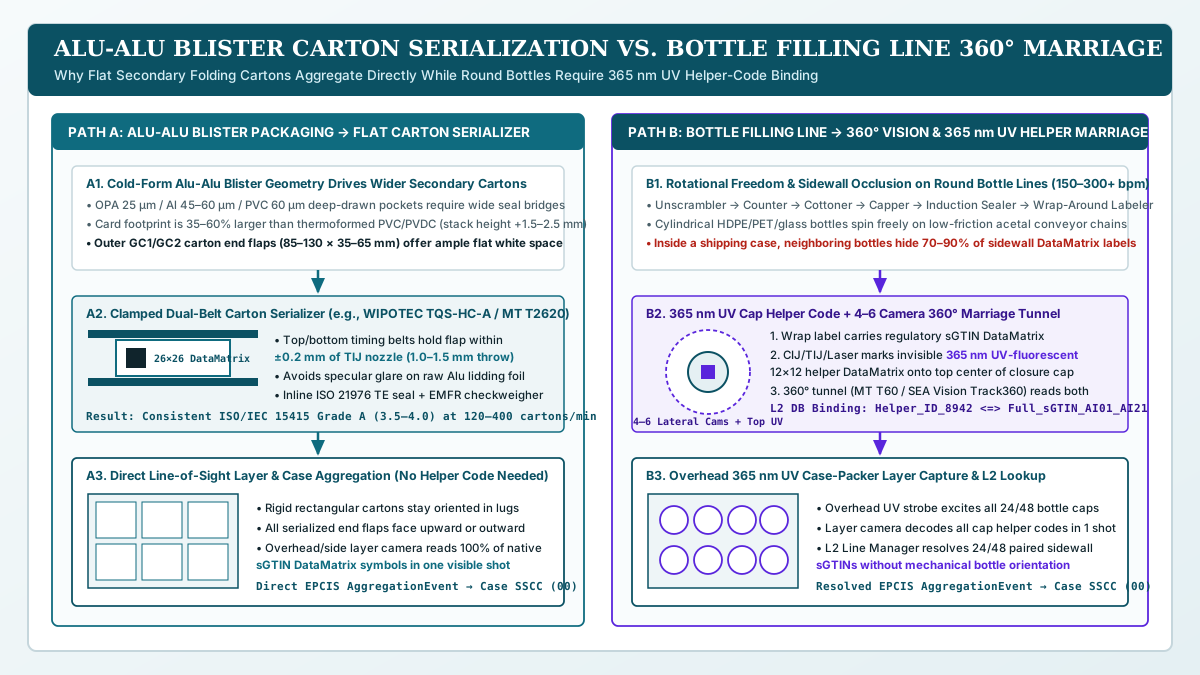
While the underlying GS1 and EPCIS data standards are identical, the physical mechanics of alu alu blister packaging lines and cylindrical bottle filling line installations require fundamentally different optical capture and aggregation architectures—a distinction rooted in the container geometry differences compared in blister and bottle packaging.
Alu-Alu blister packaging: cold-form geometry and flat secondary carton serialization
As detailed in blister packaging materials: PVC, PVDC and cold-form aluminum, alu alu blister packaging uses a multi-layer cold-formed laminate—typically 25 µm oriented polyamide (OPA) / 45–60 µm soft aluminum foil (Al) / 60 µm rigid PVC—to achieve a near-zero water-vapor transmission rate (WVTR < 0.001 g/(m²·day)). Because cold-stretched aluminum cannot be drawn at steep wall angles without pinholing, cold-form cavities require wide draw radii and broad inter-cavity seal margins. A 10-tablet alu alu blister packaging card therefore has a planar footprint 35–60% larger and a pocket dome height 1.5–2.5 mm taller than an equivalent thermoformed PVC/PVDC card.
This primary-pack geometry creates three direct engineering consequences for downstream serialization and aggregation:
- Primary aluminum foil reflection vs. secondary carton coding boundary: Printing a variable
GS1 DataMatrixdirectly onto hard-rolled20–30 µmaluminum lidding foil at the blister machine creates severe specular metallic reflection that collapsesISO/IEC 15415Symbol Contrast (SC) unless the foil is pre-printed with a matte white lacquer window or marked via dark-annealing UV/fiber laser with cross-polarized camera lighting. Unless individual cavities are perforated for hospital bedside administration under21 CFR 201.25—covered in unit dose packaging and the barcode on each cell—statutory DSCSA and EU FMD serialization is applied to the secondary outer folding carton. - Generous carton flap real estate and focal-plane clamping: Because a stack of cold-formed Alu-Alu blisters requires a wider and taller
GC1 / GC2folding carton (typically85–130 mmwidth ×35–65 mmheight), the carton end flaps offer ample flat surface area to accommodate a26 × 26DataMatrix (9.88 × 9.88 mmplus>= 1.0 mmquiet zone), four lines of human-readable text, and anISO 21976tamper-evident seal or Nordson/Robatech hot-melt glue reserve. Dual top-and-bottom servo timing belts on the carton serializer (e.g., WIPOTECTQS-HC-A, Mettler-ToledoT2620, or NeriBL A400) clamp the rigid carton flat within±0.2 mmof the1.0–1.5 mmTIJ throw distance, routinely deliveringISO/IEC 15415Grade A (3.5–4.0) quality at120–400 cartons/min. - Direct line-of-sight bundle and case aggregation: Rectangular blister cartons maintain fixed orientation through downstream pharmaceutical overwrapping and case packing. Whether cartons are grouped into clear shrink-wrapped bundles of
10or loaded layer-by-layer into a corrugated RSC shipper case, all serialized end flaps face a single plane. A single12–29 MPoverhead or side-facing camera reads100%of the nativesGTINDataMatrix symbols in one visible-light exposure without requiring any secondary helper code.
Bottle filling line integration: 360° vision tunnels and 365 nm UV helper-code marriage
A high-speed solid-dose or liquid bottle filling line—comprising a bottle unscrambler, desiccant inserter, electronic tablet/capsule counter or volumetric filler, cottoner, servo torque capper, foil induction sealer, wrap-around pressure-sensitive labeler, bundler, and case packer—processes cylindrical HDPE, PET, or amber glass bottles at 150 to 300+ bottles/min on single-file acetal conveyor chains.
Integrating serialization and case aggregation onto a bottle filling line confronts two physical obstacles that do not exist on flat carton lines:
- Uncontrolled rotational spin (
0°–360°): After the wrap-around labeler applies the pre-serialized or inline-printedGS1 DataMatrix(AI 01 + AI 21 + AI 17 + AI 10) to the cylindrical sidewall, the round bottle rotates freely on low-friction guide rails and accumulation tables. A single fixed camera cannot see the sidewall barcode if the bottle spins90°–180°away from the lens. - Line-of-sight occlusion inside the shipping case: Once
24or48cylindrical bottles are collated into a tightly packed tray or corrugated shipping case, the vertical sidewall labels are completely hidden from an overhead case-packer camera, and adjacent bottles block70–90%of the perimeter.
To achieve 100% automated case aggregation at 200–300+ bottles/min without slow mechanical bottle orienters, modern bottle filling line track-and-trace platforms (such as the Mettler-Toledo T60 Integrated 360 + T2650, SEA Vision Track360, WIPOTEC TQS-SP Bottle, or Antares Vision Matrix) execute a four-step 360° vision and 365 nm UV helper-code marriage sequence:
- Step 1 — Sidewall sGTIN marking on the wrap-around label: A thermal-transfer overprinter (
TTO),TIJ, or laser mounted on the web buffer prior to the labeling peel plate marks the regulatoryGS1 DataMatrix ECC 200and four lines of human-readable text onto each label before it wraps around the bottle body. - Step 2 — Top-cap
365 nmUV helper-code printing: Immediately after the bottle exits the labeler (or capper/induction sealer), an overhead continuous inkjet (CIJ),TIJ, or UV laser prints a compact12 × 12or14 × 14DataMatrix helper code—encoding a short8-to-12character unique token or serial reference—directly onto the top center of the closure cap (or bottle base) using invisible UV-fluorescent ink that is transparent under normal room lighting but fluoresces brightly at450–620 nmwhen excited by365 nmultraviolet LEDs. - Step 3 — Synchronous
360°marriage tunnel: While the bottles are still spaced in single file, they pass through an enclosed optical marriage station equipped with4 to 6synchronized lateral cameras arranged at60°–90°intervals around the conveyor perimeter plus one overhead365 nmUV camera. The lateral camera array reconstructs an unrolled360°cylindrical image to decode and grade the sidewallGS1 DataMatrixregardless of radial bottle spin, while the overhead UV camera simultaneously decodes the cap helper code. The L2 Line Manager writes a1-to-1database binding (Helper_ID <-> Sidewall_sGTIN) into local memory; any bottle missing either code or failingISO/IEC 15415grading is diverted into the fail-safe reject lane. - Step 4 — Overhead UV case-layer aggregation: At the downstream bundler or case packer,
24or48bottles are loaded into the shipping case in any rotational orientation. An overhead high-resolution camera strobes the open case with365 nmUV light, decodes all24or48fluorescent cap helper codes in a single top-down frame, queries the L2 marriage table to resolve the24or48paired sidewallsGTINs, and prints the parent Case SSCC (AI 00) label—completingEPCIScase aggregation at full bottle filling line speed.
QA sampling, de-aggregation SOPs, and OQ/PQ challenge reconciliation
Once an EPCIS AggregationEvent binds child sGTINs to a parent Case SSCC and Pallet SSCC, any physical change to the contents of that case without a corresponding database transaction corrupts the supply-chain inference tree. Pulling even a single carton or bottle for in-process quality control (IPC), stability testing, or retention archiving after aggregation creates an orphan / phantom serial mismatch: the outbound EPCIS file transmitted to the wholesale distributor claims 50 active units inside the case when only 49 physical packs arrive at the receiving dock, triggering a statutory DSCSA quarantine hold.
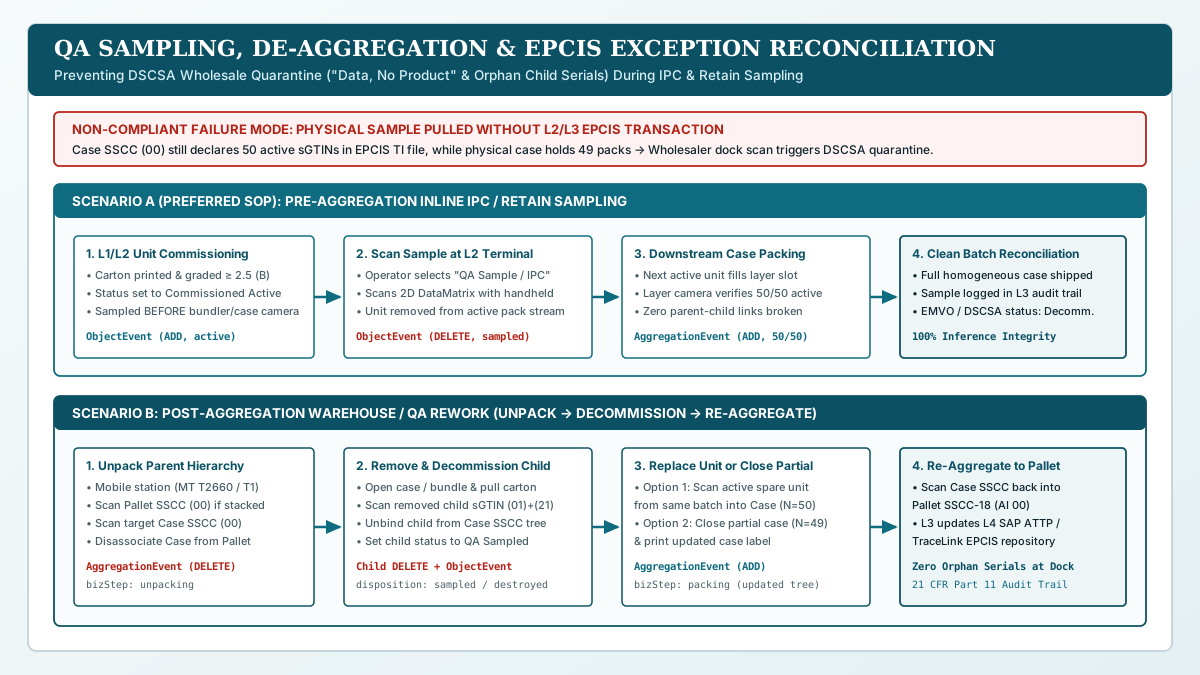
To prevent wholesale quarantine exceptions, standard operating procedures (SOPs) and 21 CFR Part 11 audit trails enforce two distinct workflows depending on where the sample is taken:
- Scenario A — Pre-Aggregation Inline Sampling (Preferred SOP): Quality or line operators pull the sample carton or bottle after L1/L2 unit commissioning verification (
ISO/IEC 15415 >= 2.5) but upstream of the bundle or case-layer aggregation camera. The operator scans the removed pack at the L2 HMI or dedicated sampling scanner, selecting dispositionSampled / Decommissioned(EPCIS ObjectEvent,action: DELETE/bizStep: sampling). The downstream case packer automatically fills the layer with the next consecutive active pack (50/50active units), so no parent-childAggregationEventever needs to be broken. - Scenario B — Post-Aggregation Unpack, Decommission, and Re-Aggregate SOP: When a QA inspector or warehouse operator must pull a sample from an already sealed and aggregated shipping case (using a mobile rework station such as a Mettler-Toledo
T2660 MASor UhlmannT1):- Unpack parent hierarchy: Scan the parent
Pallet SSCC (00)andCase SSCC (00)to execute anEPCIS AggregationEvent(action: DELETE,bizStep: unpacking) disassociating the target case from the pallet. - Delete and decommission removed child: Scan the
GS1 DataMatrixon the specific child carton or bottle being removed. The L3/L2 terminal executes anAggregationEvent(action: DELETE) removing that childsGTINfrom the parentCase SSCC, immediately followed by anObjectEventchanging the removed unit’s disposition fromactivetosampled/destroyed. - Replace unit or close partial case: Either scan a commissioned, un-aggregated active spare unit from the same batch into the parent
Case SSCC(AggregationEvent,action: ADD) to restore the full50-unitcount, or close the case as a verified partial case (N = 49) and print an updated case quantity label. - Re-aggregate case to pallet: Scan the updated
Case SSCCback into the parentPallet SSCC-18(AggregationEvent,action: ADD,bizStep: packing) so the outboundEPCIS 1.2 / 2.0hierarchy matches the physical shipment100%.
- Unpack parent hierarchy: Scan the parent
OQ/PQ serialization and aggregation challenge matrix
During Operational Qualification (OQ) and Performance Qualification (PQ), validation engineers must challenge every optical, database, and mechanical interlock at rated line speed and incorporate the acceptance criteria into the packaging equipment URS checklist:
| Challenge Test ID | Seeded Defect / Exception Scenario | Target Detection Layer & Hardware | Required Machine & EPCIS L2/L3 Response | Qualification Acceptance Criterion |
|---|---|---|---|---|
| OQ-SER-01 | Sub-grade or damaged DataMatrix (ISO/IEC 15415 Grade D / 1.0 or occluded L-finder bar via tape/blocked TIJ nozzle) |
L1 unit vision camera (ISO/IEC 15415 threshold < 2.5 / B) |
Do not commission sGTIN as active; track via encoder shift register into locked coding-reject bin |
10/10 sub-grade packs diverted to coding-reject bin; 0 commissioned as active |
| OQ-SER-02 | Malformed GS1 syntax or missing <GS> (ASCII 29) after variable-length AI (10) |
L1/L2 GS1 application identifier parser & OCV human-readable mismatch check | Flag syntax failure; reject pack; block batch start if master recipe template violates GS1 syntax | 10/10 syntax-fault packs rejected; recipe parser blocks invalid AI string |
| OQ-SER-03 | Bottle 365 nm UV helper-code mismatch or missing cap code on 360° marriage tunnel |
L1/L2 360° lateral camera array + overhead 365 nm UV cap camera |
Fail 1:1 marriage binding in L2 database; divert bottle at marriage-station reject gate before case packer |
10/10 un-married bottles rejected prior to case-layer accumulation |
| OQ-SER-04 | Case-layer short count or uncommissioned (“rogue”) unit inserted into shipper layer (49 packs or 1 uncommissioned pack) |
L1/L2 overhead layer camera (12–29 MP visible or 365 nm UV) + L2 status lookup |
Halt layer transfer / suppress parent Case SSCC label print; highlight exact grid coordinates of missing/rogue pack on L2 HMI |
100% of short or rogue layers blocked from printing parent Case SSCC label |
| OQ-SER-05 | Unconfirmed reject actuator fault (defective serialized carton triggered with compressed air disabled) | L1 reject bin entry confirmation photoeye fails to detect pack within encoder window Δθ |
Immediate fail-safe line stop before defective pack exits serializer conveyor; require supervisor key/password reset | Line halts on 100% of unconfirmed reject challenges; zero defective packs reach bundler/case packer |
Align these qualification tests with the component and regulatory definitions in the pharmaceutical packaging glossary and the upstream pharmaceutical cartoning machine guide to maintain uninterrupted traceability from the primary packaging line through wholesale and pharmacy distribution.