The Drug Supply Chain Security Act outlines steps to establish an interoperable, electronic way to identify and trace certain prescription drugs at the package level across the United States pharmaceutical supply chain, helping prevent harmful drugs from entering, detect harmful drugs if they enter, and enable a rapid response to remove them to protect patients. Across each ownership transfer in the medicine supply chain, manufacturers, repackagers, wholesale distributors, and dispensers transact only with authorized trading partners, exchange electronic transaction information and transaction statements, quarantine and investigate suspect products, and operate under enhanced package-level security requirements that remain in effect for all trading partners outside FDA’s small-business-dispenser exemption running until November 27, 2027.
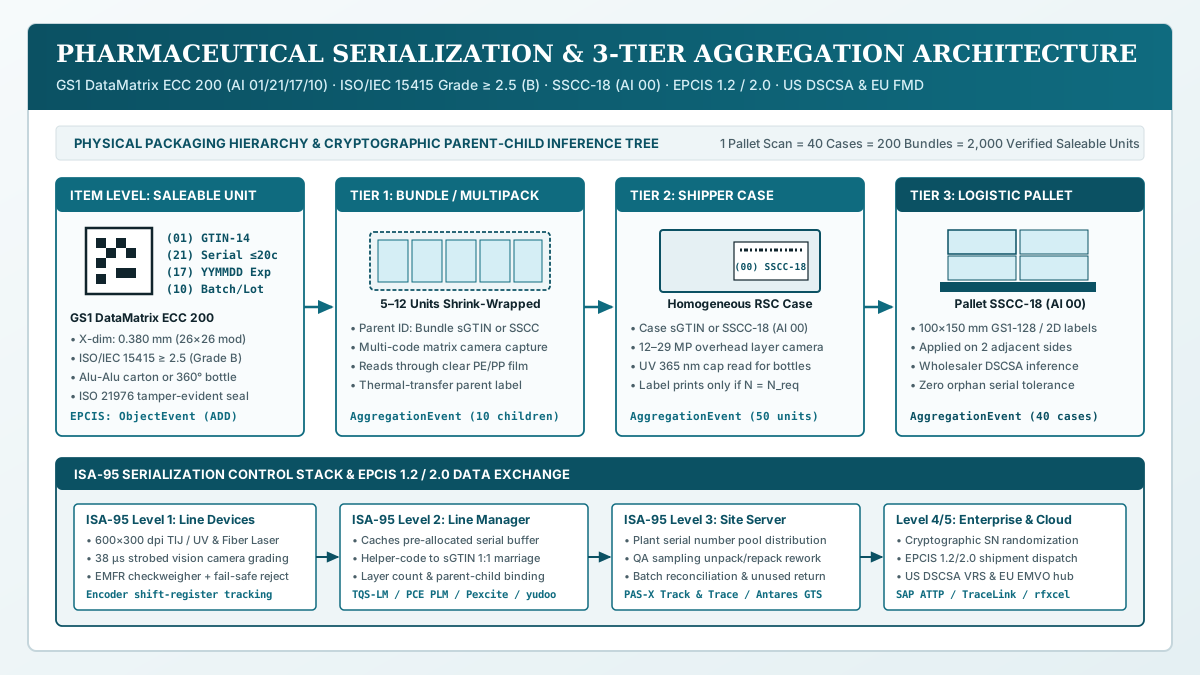
On a package, the DSCSA product identifier appears in human-readable text and a 2-dimensional data matrix barcode, while physical tamper-evident packaging and pharmaceutical serialization and aggregation levels cover the separate barrier and aggregation topics.
Which prescription drug packages and transactions does DSCSA cover?
Under the statutory definitions in section 581, a product is a prescription drug for human use in a finished dosage form for administration to a patient without substantial further manufacturing, such as capsules, tablets, and lyophilized products before reconstitution. A package is the smallest individual saleable unit of product for distribution by a manufacturer or repackager that is intended for ultimate sale to a dispenser, and a homogeneous case is a sealed case containing only product with a single National Drug Code number belonging to a single lot.
For purposes of section 360eee-1 of title 21, the statutory product definition excludes blood or blood components intended for transfusion, radioactive drugs or radioactive biological products defined in 21 CFR 600.3(ee) and regulated by the Nuclear Regulatory Commission or an agreement State under section 2021 of title 42, imaging drugs, specified intravenous products, medical gas as defined in section 360ddd, homeopathic drugs marketed under applicable guidance, and drugs compounded in compliance with section 353a or 353b. FDA’s product-tracing FAQ adds over-the-counter drugs and animal drugs to the plain-language list of excluded products. A dispenser definition excludes any person who dispenses only products to be used in animals, and a veterinarian or veterinary clinic using human prescription drugs solely in animals has no DSCSA product-tracing obligations.
Tracing duties attach to a transaction, defined as a transfer of product between persons in which a change of ownership occurs. Distribution encompasses the sale, purchase, trade, delivery, handling, storage, or receipt of a product, excluding the dispensing of a product pursuant to a prescription. Statutory exclusions from the transaction definition cover intracompany distribution within a manufacturer or among affiliates, distribution among hospitals or health care entities under common control, dispensing pursuant to a prescription under section 353(b)(1), distribution of product samples by a manufacturer or licensed wholesale distributor under section 353(d), and distribution for emergency medical reasons including a public health emergency declaration under section 247d of title 42, with the statute specifying that a drug shortage not caused by a public health emergency does not constitute an emergency medical reason.
Dispenser tracing and verification duties in paragraphs (1) and (4) do not apply to licensed health care practitioners authorized to prescribe or administer medication under State law, or other licensed individuals under their supervision or direction, when dispensing or administering product in the usual course of professional practice. When a pharmacy sells a product to another pharmacy, product-tracing requirements apply unless the sale fulfills a specific patient need, meaning a transfer from a pharmacy to another pharmacy to fill a prescription for an identified patient rather than replenishing stock in anticipation of a potential need. Under FDA’s waivers, exceptions, and exemptions guidance, an authorized trading partner may also request a waiver for undue economic hardship or emergency medical reasons including a section 319 public health emergency declaration, and a manufacturer or repackager may request a product-identifier exception when a container is too small or unable to accommodate a label with sufficient space for section 582 compliance.
How did federal pedigree rules evolve into DSCSA electronic tracing?
Federal wholesale anti-diversion rules began with the Prescription Drug Marketing Act of 1987 (Public Law 100-293), signed into law by President Ronald Reagan on April 22, 1988 to discourage the sale of counterfeit, adulterated, misbranded, subpotent, and expired prescription drugs, and modified on August 26, 1992 by the Prescription Drug Amendments of 1992 (Public Law 102-353). FDA issued implementing regulations in 1990 at 21 CFR Part 205 and in 1999 at 21 CFR Part 203.
Congress enacted DSCSA as title II of Public Law 113-54 on November 27, 2013, adding section 581 definitions, replacing the wholesale drug pedigree language with licensing and uniform national wholesale standards in section 503(e), and adding section 582 product-tracing requirements for most human prescription drugs in finished form. According to FDA’s product-tracing FAQ, as of January 1, 2015, the statutory pedigree provision added by the 1987 Act, which had required certain wholesale distributors to provide a statement identifying each prior sale, purchase, or trade of a drug, no longer exists and is no longer in effect.
The online Electronic Code of Federal Regulations display of 21 CFR Part 203, up to date as of 11/12/2026 as a continuously updated online version rather than an official legal edition of the Code of Federal Regulations, still prints 21 CFR 203.50, including the prior-sale identifying statement for wholesale sales by sellers that are not authorized distributors of record and a 3-year retention printed in 21 CFR 203.50 that also subjects that statement to section 203.60. That printed 21 CFR 203.50 text reflects the older Prescription Drug Marketing Act rule rather than active DSCSA product tracing, which governs current wholesale and pharmacy transactions and requires maintaining tracing records for not less than 6 years.
DSCSA itself phased out its interim lot-level chain-of-custody document once package-level electronic tracing took effect. During the initial DSCSA phase starting in 2015, ownership transfers included transaction history, defined as a paper or electronic statement containing the transaction information for each prior transaction going back to the manufacturer. Under section 360eee-1, 10 years after November 27, 2013, and as confirmed in FDA’s exemption letters for section 582(k)(1) beginning on November 27, 2023, the requirement to provide and receive transaction history has no force or effect, leaving package-level transaction information and the transaction statement as the required transaction records.

| Tracing regime | Statutory or regulatory source | Core transfer records | Package serial and retention scope | Current legal status |
|---|---|---|---|---|
| Prescription Drug Marketing Act wholesale pedigree | Public Law 100-293 (1987); displayed text at 21 CFR 203.50 | Statement by unauthorized wholesale distributors identifying each prior sale, purchase, or trade back to the manufacturer | Lot or control number without package serials; 3-year retention printed in 21 CFR 203.50(b) | Statutory pedigree provision ended on January 1, 2015; 21 CFR 203.50 remains displayed in eCFR as of 11/12/2026 |
| Initial DSCSA lot-level product tracing | Public Law 113-54, section 582 (effective January 1, 2015 for manufacturers and wholesalers; July 1, 2015 for dispensers) | Transaction information, transaction history back to the manufacturer, and transaction statement in paper or electronic form | Baseline transaction information carries lot number without package serials; records kept for not less than 6 years | Transaction history requirement lost force and effect on November 27, 2023 under section 582(k)(1) |
| Enhanced DSCSA package-level electronic tracing | Section 582(g)(1), taking effect 10 years after November 27, 2013 | Secure, interoperable electronic exchange of transaction information and transaction statements without transaction history | Transaction information includes the package-level product identifier for each package; records kept for not less than 6 years | In effect for manufacturers, repackagers, wholesale distributors, and larger dispensers; small dispensers exempt from listed enhanced items until November 27, 2027 |
What duties apply to trading partners and third-party logistics providers?
Section 581 divides trading partners into entities that transfer or accept direct ownership of a product and logistics entities that accept or transfer direct possession without taking title. Ownership trading partners comprise manufacturers (persons holding an approved application under section 355 or a biologics license under section 262 of title 42, or manufacturing an unapproved product, along with specified co-licensed partners and affiliates), repackagers, wholesale distributors, and dispensers (retail pharmacies, hospital pharmacies, groups of chain pharmacies under common ownership and control that do not act as wholesale distributors, other persons authorized by law to dispense or administer prescription drugs, and their affiliated warehouses or distribution centers).
A third-party logistics provider provides or coordinates warehousing or other logistics services in interstate commerce on behalf of a manufacturer, wholesale distributor, or dispenser without taking ownership of the product and without responsibility to direct its sale or disposition. Although third-party logistics providers are defined as trading partners under section 581(23)(B) for possession transfers, FDA’s August 6, 2026 letter states that third-party logistics providers are not subject to the product-tracing requirements of section 582, so they do not issue ownership transaction statements.
Beginning not later than January 1, 2015, the trading partners of a manufacturer, wholesale distributor, or dispenser may be only authorized trading partners. As FDA advises pharmacists, pharmacies confirm registration or licensure before conducting business. Under section 581(2), authorization means holding a valid drug establishment registration under section 360 for a manufacturer or repackager, holding a valid State or section 360eee-2 federal license in accordance with section 360eee-1(a)(6) plus section 353(e) licensure reporting for a wholesale distributor, holding a valid State or section 360eee-3(a)(1) federal license in accordance with section 360eee-1(a)(7) plus section 360eee-3(b) reporting for a third-party logistics provider, and holding a valid State license for a dispenser.
| Supply-chain entity | Authorized status requirement | Product-identifier and transaction-exchange duties | Recordkeeping and saleable-return rules |
|---|---|---|---|
| Manufacturer | Valid establishment registration under section 360 | Affix or imprint a product identifier to each package and homogeneous case beginning not later than 4 years after November 27, 2013; provide electronic transaction information and transaction statements at or before ownership transfer (with a statutory paper exception for specified licensed prescribing practitioners) | Maintain transaction records and product-identifier information for not less than 6 years; associate saleable returns with transaction information and transaction statements under enhanced rules |
| Wholesale distributor | Valid State or section 360eee-2 license under section 360eee-1(a)(6) and licensure reporting under section 353(e) | Refuse ownership without required tracing documentation (from January 1, 2015); transact only products encoded with a product identifier beginning 6 years after November 27, 2013 unless grandfathered; exchange electronic package-level transaction information and transaction statements | Store tracing records for not less than 6 years; verify the product identifier, including the standardized numerical identifier, for each sealed homogeneous case of a returned product or on each package if the product is not in a sealed homogeneous case, before further distribution, and associate saleable returns with the transaction information and transaction statement |
| Dispenser (pharmacy) | Valid license under State law | Refuse ownership without tracing documentation (from July 1, 2015); transact only products encoded with a product identifier beginning not later than 7 years after November 27, 2013 unless grandfathered; provide tracing documentation when selling to another trading partner unless dispensing to a patient or fulfilling a specific patient need | Maintain tracing documentation for not less than 6 years (directly or under a written agreement by which a third party confidentially maintains the records, which does not relieve the dispenser’s obligations); small dispensers hold a temporary exemption from listed enhanced items until November 27, 2027 |
| Third-party logistics provider | Valid State or section 360eee-3(a)(1) license under section 360eee-1(a)(7) and licensure reporting under section 360eee-3(b) | Accepts or transfers direct possession for warehousing or logistics without taking ownership or directing sale or disposition; not subject to section 582 product-tracing document exchange | Does not transfer ownership and does not generate ownership transaction information or transaction statements under section 582 |
How do product identifiers and GS1 EPCIS support package-level exchange?
A statutory product identifier is a standardized graphic carrying, in both human-readable form and on a machine-readable data carrier conforming to standards from a widely recognized international standards development organization, the standardized numerical identifier, the lot number, and the expiration date. The standardized numerical identifier uniquely identifies each package or homogeneous case by combining the National Drug Code corresponding to that specific product and package configuration with a unique alphanumeric serial number of up to 20 characters. Unless FDA allows other technologies by guidance, the product-identifier data must appear in a 2-dimensional data matrix barcode when affixed to or imprinted upon a package, and in either a linear barcode or a 2-dimensional data matrix barcode when affixed to or imprinted upon a homogeneous case.
Baseline transaction information lists the proprietary or established name of the product, strength and dosage form, National Drug Code number, container size, number of containers, lot number, transaction date, shipment date if more than 24 hours after the transaction date, and the business names and addresses of the person transferring ownership and the person receiving ownership. That baseline list does not itself include the serial number. Under the enhanced drug distribution security provisions taking effect 10 years after November 27, 2013, transaction information must include the product identifier at the package level for each package in the transaction, and both transaction information and the transaction statement (which attests that the transferor is authorized, received the product and tracing records from an authorized prior owner, did not knowingly ship a suspect or illegitimate product, maintained verification systems, and did not knowingly provide false transaction information or alter transaction history) must be exchanged in a secure, interoperable, electronic manner.
FDA has not established standardized government forms for transaction information or transaction statements. For the enhanced security requirements in section 582(g)(1), FDA recommends using the GS1 Electronic Product Code Information Services (EPCIS) standard, a global GS1 standard for creating and sharing visibility event data within and across enterprises whose listed current specification is Version 2.0, June 2022. FDA notes that DSCSA does not require trading partners to obtain a specific location identifier such as a Global Location Number, though a supplier or wholesale partner may ask a pharmacy to obtain a Global Location Number as a business requirement to facilitate EPCIS data exchange because it is a data element of EPCIS.
How do verification, suspect quarantine, and small-dispenser exemptions work?
Verification means determining whether the product identifier affixed to or imprinted upon a package or homogeneous case corresponds to the standardized numerical identifier or lot number and expiration date assigned to the product by the manufacturer or the repackager, and that determination may use human-readable or machine-readable methods. Under section 582(g)(1)(C), package-level verification systems and processes may include the use of aggregation and inference as necessary, and aggregation capture is detailed in pharmaceutical serialization and aggregation levels.
A mismatch between a physical package and the manufacturer’s assigned records carries immediate statutory consequences. Beginning 4 years after November 27, 2013, upon receiving a verification request from an authorized repackager, wholesale distributor, or dispenser, a manufacturer must respond within 24 hours (or other reasonable time determined by the Secretary) stating whether the product identifier corresponds to what the manufacturer affixed or imprinted, and if it does not correspond, the manufacturer must treat the product as suspect and conduct an investigation. Under the enhanced rules, a party accepting a saleable return may accept it only when able to associate the returned product with its transaction information and transaction statement. In FDA’s October 9, 2024 exemption letter, trading partners reported that resolving missing or erroneous data in electronic transaction information and transaction statements posed challenges capable of significantly delaying product distribution, including drugs in shortage.
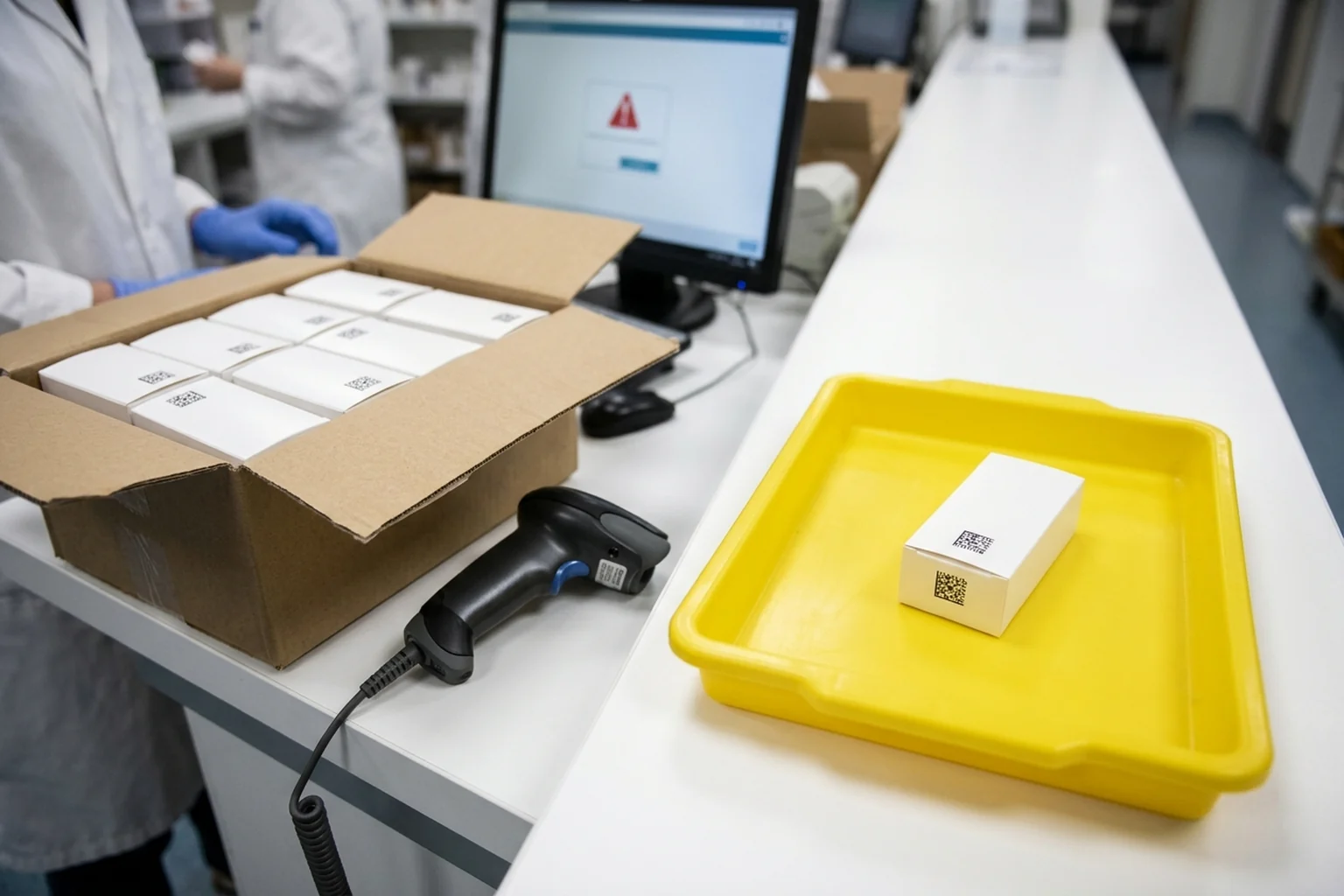
DSCSA separates suspect products from illegitimate products by the evidentiary threshold. A suspect product is one for which there is reason to believe the product is potentially counterfeit, diverted, or stolen, potentially intentionally adulterated such that it would result in serious adverse health consequences or death to humans, potentially the subject of a fraudulent transaction, or appears otherwise unfit for distribution such that it would result in serious adverse health consequences or death to humans. When a manufacturer or dispenser determines that a product in its possession or control is suspect (or receives a verification request from the Secretary), it must quarantine the product, storing or identifying it in a physically separate area clearly identified for that use or through other procedures to prevent distribution or transfer, and promptly investigate in coordination with trading partners. Beginning 7 years after November 27, 2013, a dispenser’s suspect-product investigation includes verifying whether the product identifier corresponds on at least 3 packages or 10 percent of the suspect product, whichever is greater, or on all packages when fewer than 3 are present, unless covered by the small-dispenser exemption.
An illegitimate product is one for which credible evidence shows that the product is counterfeit, diverted, or stolen, is intentionally adulterated such that it would result in serious adverse health consequences or death to humans, is the subject of a fraudulent transaction, or appears otherwise unfit for distribution such that it would be reasonably likely to result in serious adverse health consequences or death to humans. Upon determining that a product is illegitimate (for a dispenser, in coordination with the manufacturer), manufacturers, repackagers, wholesale distributors, and dispensers must notify FDA and immediate trading partners within 24 hours, and manufacturers must also notify FDA and appropriate trading partners within 24 hours after determining a product is at high risk for illegitimacy. FDA directs trading partners to submit notifications through the 3911 platform in CDER NextGen, its preferred method, or by emailing Form FDA 3911, and dispensers shall keep investigation records for not less than 6 years after concluding a suspect-product investigation and disposition records for not less than 6 years after concluding an illegitimate-product disposition.
Transition timelines for larger trading partners have already closed. FDA’s August 2023 compliance policies established a stabilization period until November 27, 2024, and FDA’s October 9, 2024 exemption letter granted phased exemptions that expired on May 27, 2025 for eligible manufacturers and repackagers, August 27, 2025 for eligible wholesale distributors, and November 27, 2025 for eligible dispensers with 26 or more full-time employees. As stated on FDA’s DSCSA exemptions page and in FDA’s August 6, 2026 letter, enhanced drug distribution security requirements remain in effect for all trading partners that do not meet the small-business-dispenser definition.
For small business dispensers, defined as companies owning a dispenser with 25 or fewer full-time employees licensed as pharmacists or qualified as pharmacy technicians as of November 27, 2026 (applying the Internal Revenue Service standard of an employee employed on average at least 30 hours of service per week, or 130 hours of service per month, for a calendar month), FDA extended exemptions from November 27, 2026 until November 27, 2027 because steps under the statutory section 582(g)(3) small-dispenser assessment were still unfinished. During this window through November 27, 2027, small business dispensers and their trading partners may continue exchanging transaction information without package-level product identifiers for each package, and small business dispensers are exempt from the section 582(d)(4)(A)(ii)(II) and (B)(iii) requirement to verify product identifiers on the statutorily designated proportion of suspect or illegitimate product, while remaining obligated to fulfill all other section 582(d)(4) verification duties including quarantine and investigation. Small business dispensers and their trading partners do not need to submit additional information to FDA to use these exemptions, and FDA recommends communicating reliance to trading partners while continuing implementation efforts rather than delaying enhanced security readiness.