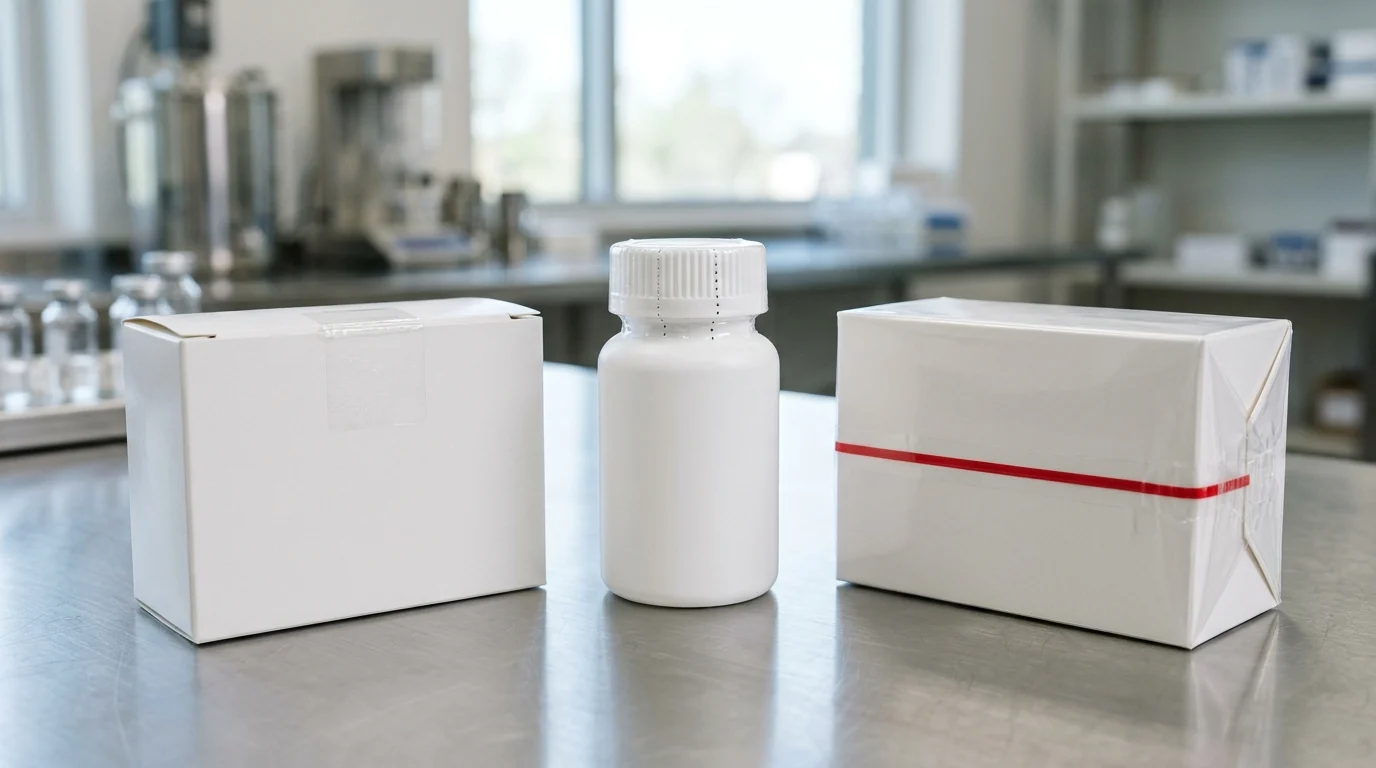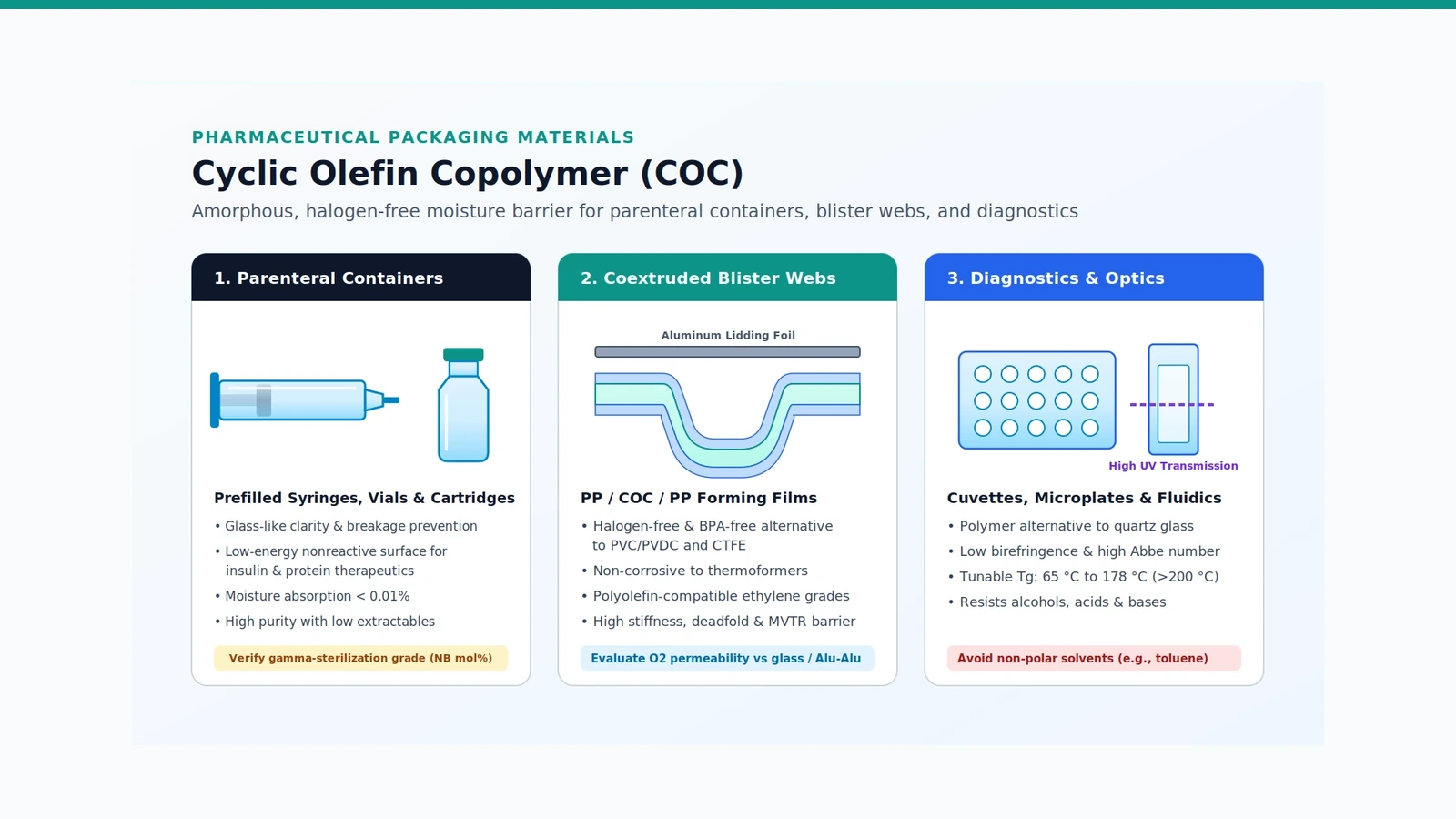
Cyclic olefin copolymer (COC) is an amorphous, halogen-free, BPA-free thermoplastic produced by chain copolymerizing cyclic monomers with ethylene. It combines glass-like clarity, moisture absorption below 0.01%, low extractables, and a high moisture barrier for parenteral vials, prefilled syringes, and coextruded blister webs, while remaining vulnerable to non-polar solvents such as toluene.
Within pharmaceutical packaging, specifying COC requires separating its moisture-barrier and purity strengths from its sterilization, solvent, and gas-permeation boundaries. Selecting the right monomer ratio and multilayer architecture prevents qualification failures across both injection-molded parenteral containers and thermoformed blister packs.
What makes cyclic olefin copolymer an amorphous medical-grade thermoplastic with glass-like clarity?
Cyclic olefin copolymer is an amorphous polymer whose optical transparency, low birefringence, high Abbe number, and high ultraviolet transmission closely resemble glass while delivering thermoplastic impact resistance and dimensional stability. With moisture absorption below 0.01%, high purity, low extractables, and halogen-free, BPA-free chemistry, COC serves medical containers, blister films, lenses, displays, and analytical devices.
Unlike semi-crystalline polyolefins that scatter light through crystalline domains, COC stays fully amorphous across its processing window (Wikipedia: Cyclic olefin copolymer). Typical COC resins exhibit a higher modulus than HDPE and PP, comparable to PET or polycarbonate, while avoiding the moisture sensitivity that causes dimensional drift in polycarbonate and acrylics.
Because COC absorbs less than 0.01% water, molded walls and micro-scale features do not swell in humid storage or aqueous contact (PubMed Central ethylene-norbornene characterization study). In medical and analytical uses, COC is recognized as a high-purity polymer with low extractables, and some grades have demonstrated a lack of estrogenic activity alongside halogen-free and BPA-free formulation.
| Property category | Verified COC characteristic | Engineering relevance in packaging |
|---|---|---|
| Polymer morphology | Amorphous thermoplastic | Delivers glass-like transparency, low birefringence, and post-molding dimensional stability |
| Mechanical modulus | Higher than HDPE and PP; comparable to PET or PC | Supports rigid blister cavities and precision-molded syringe barrels |
| Moisture absorption | Below 0.01% by weight | Prevents dimensional swelling and preserves optical fidelity over polycarbonate and acrylics |
| Glass transition temperature (Tg) | 65 °C to 178 °C in commercial grades; can exceed 200 °C | Matches resin heat resistance to thermoforming or sterilization requirements |
| Purity and composition | Halogen-free, BPA-free, low extractables | Reduces container-drug interaction risks in parenteral and analytical uses |
| Optical transmission | High visible and UV transmission, high Abbe number | Enables visual inspection of parenterals and polymer replacement of quartz glass in diagnostics |
How do chain-copolymerized COC grades compare structurally with ring-opened cyclo-olefin polymers?
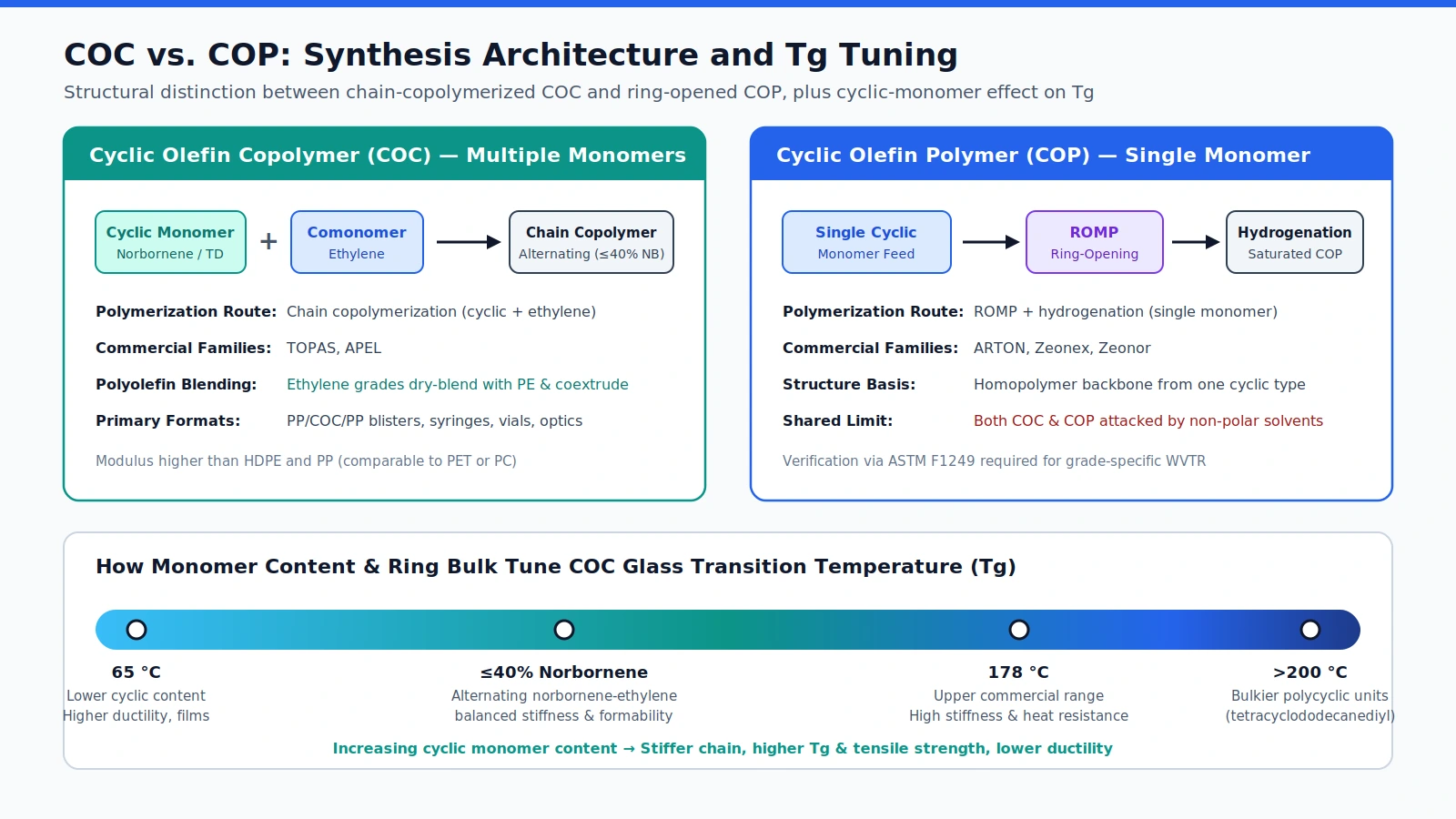
The core structural distinction between COC and cyclic olefin polymer (COP) is monomer count and synthesis route: COC is made by chain copolymerizing multiple monomers—typically norbornene or tetracyclododecene with ethylene—whereas COP is made from a single cyclic monomer via ring-opening metathesis polymerization (ROMP) followed by hydrogenation. Varying cyclic monomer content tunes COC glass transition temperature from 65 °C to 178 °C and beyond 200 °C.
Commercial COC families include TOPAS and APEL, while commercial COP families produced by ROMP and hydrogenation include ARTON, Zeonex, and Zeonor (Wikipedia: Cyclic olefin copolymer; PubMed Central ethylene-norbornene study). Because both families share cyclo-olefin hydrocarbon backbones, packaging teams often group them together, yet their polymerization chemistry creates practical differences in blending and thermal tuning.
In COC copolymers containing up to 40% norbornene, the backbone consists of alternating norbornene and ethylene sequences (PubMed Central ethylene-norbornene study). Raising the norbornene fraction stiffens the main chain, increasing glass transition temperature and tensile strength while decreasing ductility. Substituting bulkier polycyclic tetracyclododecanediyl units in place of bicyclic norbornanediyl units further restricts local chain-segment motion and raises Tg even higher.
| Comparison dimension | Cyclic olefin copolymer (COC) | Cyclic olefin polymer (COP) |
|---|---|---|
| Monomer count | Multiple monomers (cyclic monomer plus ethylene) | Single type of cyclic monomer |
| Synthesis route | Chain copolymerization | Ring-opening metathesis polymerization (ROMP) followed by hydrogenation |
| Commercial resin families | TOPAS, APEL | ARTON, Zeonex, Zeonor |
| Polyolefin blendability | Ethylene-based grades dry-blend with PE and coextrude with polyolefins | Single-monomer backbone without ethylene comonomer sequences |
| Thermal tuning range | Commercial Tg from 65 °C to 178 °C; grades can exceed 200 °C | Grade-dependent amorphous thermal profile |
| Shared solvent limit | Attacked by non-polar organic solvents such as toluene | Attacked by non-polar organic solvents such as toluene |
How do COC and COP differ in blister webs versus prefilled syringes?
Both COC and COP support precision injection molding for medical parts, but ethylene-based COC grades offer direct compatibility with polyethylene and polyolefins for cast or blown film extrusion, dry blending, and coextruded thermoforming blister webs. For injection-molded prefilled syringes, gamma sterilization introduces norbornene-dependent microstructural shifts that must be qualified per resin grade and absorbed dose.
Processing routes and polyolefin blendability
COC pellets run on standard polymer conversion equipment including single- and twin-screw extrusion, injection molding, injection blow molding, injection stretch blow molding (ISBM), compression molding, extrusion coating, biaxial orientation, and thermoforming (Wikipedia: Cyclic olefin copolymer). Parts exhibit high dimensional stability with little post-processing change.
In film converting, COC is commonly extruded on cast or blown film lines as a functional modifier in monolayer or multilayer structures to contribute barrier, stiffness, and forming properties that base polyolefins lack. Because ethylene-based COC grades are compatible with polyethylene, converters can dry-blend COC with PE on commercial blending equipment or coextrude COC cores with polypropylene skins (PubMed Central gamma irradiation study).
Gamma sterilization and syringe packaging line considerations
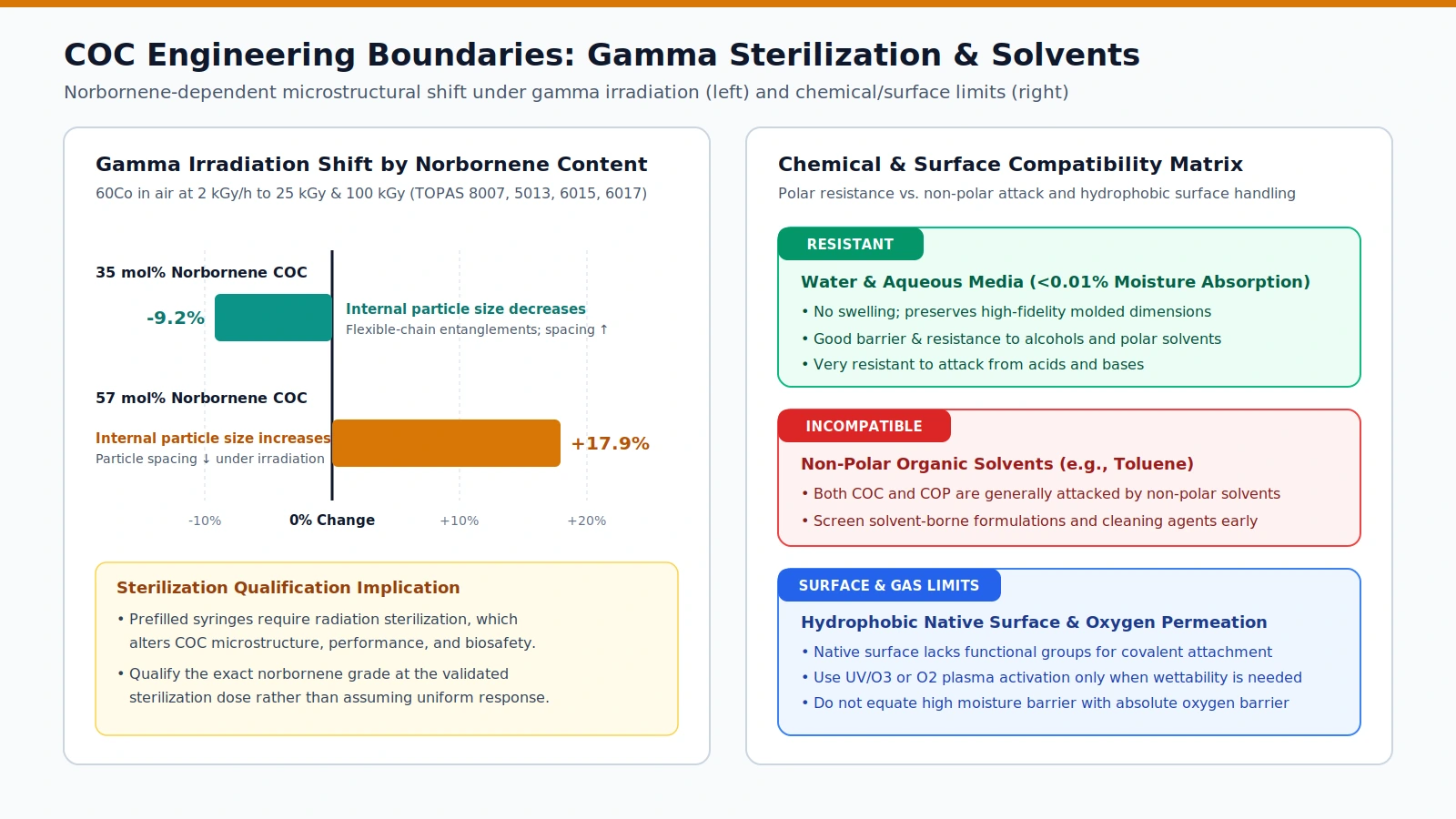
When COC is molded into prefilled syringes and pharmaceutical containers, terminal radiation sterilization alters the polymer microstructure, which can affect mechanical performance and biosafety (PubMed Central gamma irradiation study). In an NMR and SAXS characterization study of TOPAS grades 8007, 5013, 6015, and 6017 irradiated in air with a 60Co gamma source at 2 kGy/h to absorbed doses of 25 kGy and 100 kGy, norbornene concentration inverted the microstructural response.
At 35 mol% norbornene, gamma irradiation generated free radicals that triggered migration and chain entanglements within flexible ethylene-rich segments, causing a 9.2% decrease in internal particle size and an increase in particle spacing. At 57 mol% norbornene, the higher cyclic-ring concentration produced a 17.9% increase in internal particle size and a decrease in particle spacing. Teams running polymer barrels on a syringe packaging machine therefore pair breakage-resistance advantages over glass with grade-specific post-irradiation qualification.
Which biologics, parenteral vials, and diagnostic consumables drive pharmaceutical cyclic olefin copolymer uses?
Pharmaceutical COC adoption is driven by parenteral vials, prefilled syringes, and cartridges for insulin and protein drugs, where breakage prevention, weight reduction, low extractables, and a low-energy nonreactive surface help protect formulation purity and shelf life. Outside primary drug containers, high UV transmission and moisture absorption below 0.01% make COC a leading polymer alternative to quartz glass in diagnostic cuvettes and microplates.
Glass containers remain standard across many parenterals, yet glass breakage during filling, transport, or clinical handling creates safety and yield risks. COC’s combination of high purity, moisture barrier, clarity, and sterilization compatibility positions it as a shatter-resistant, lower-weight glass alternative across medical products (Wikipedia: Cyclic olefin copolymer).
For biologic therapies such as insulin and other protein drugs, COC provides a very low-energy, nonreactive contact surface that helps preserve medication purity and extend shelf life inside vials, syringes, and cartridges. In analytical and diagnostic workflows, optimized COC grades transmit ultraviolet light efficiently and avoid moisture-induced swelling, supporting cuvettes, microplates, and micro- or nanofluidic substrates (PubMed Central ethylene-norbornene study).
Choosing between rigid parenteral containers and solid-dose formats also depends on the wider packaging hierarchy covered in primary, secondary, and tertiary packaging and the solid-dose container trade-offs analyzed in blister versus bottle packaging.
Why do halogen-free blister webs coextrude a cyclic olefin copolymer film core between polyolefin skins?
Coextruding a COC core between polypropylene skins (PP/COC/PP) captures COC’s moisture barrier, stiffness, deadfold, heat resistance, and thermoformability while controlling resin cost and preserving polyolefin processability. This halogen-free architecture provides a non-corrosive pharmaceutical blister alternative to PVC/PVDC and CTFE, and multilayer stacking lengthens moisture and oxygen permeation pathways compared with single-layer polymer film.
Pharmaceutical blister packaging frequently relies on a high percentage of COC in the forming web to upgrade barrier and pocket stiffness over base polyolefins (Wikipedia: Cyclic olefin copolymer). Research at the Rochester Institute of Technology evaluated coextruded PP/COC/PP olefin structures against halogen-based PVC/PVDC specifically to identify an alternative that is neither environmentally harmful nor corrosive to pharmaceutical packaging equipment (Rochester Institute of Technology blister thesis).
The RIT evaluation benchmarked PP/COC/PP against PVC/PVDC across six qualification criteria: moisture vapor transmission rate (MVTR), vacuum leak testing, peel strength, machinability and formability on an Uhlmann UPS4 thermoformer, layer distribution, and financial impact. The study concluded that COC provides the properties required to adequately protect pharmaceutical products while remaining environmentally safer than PVDC and CTFE.
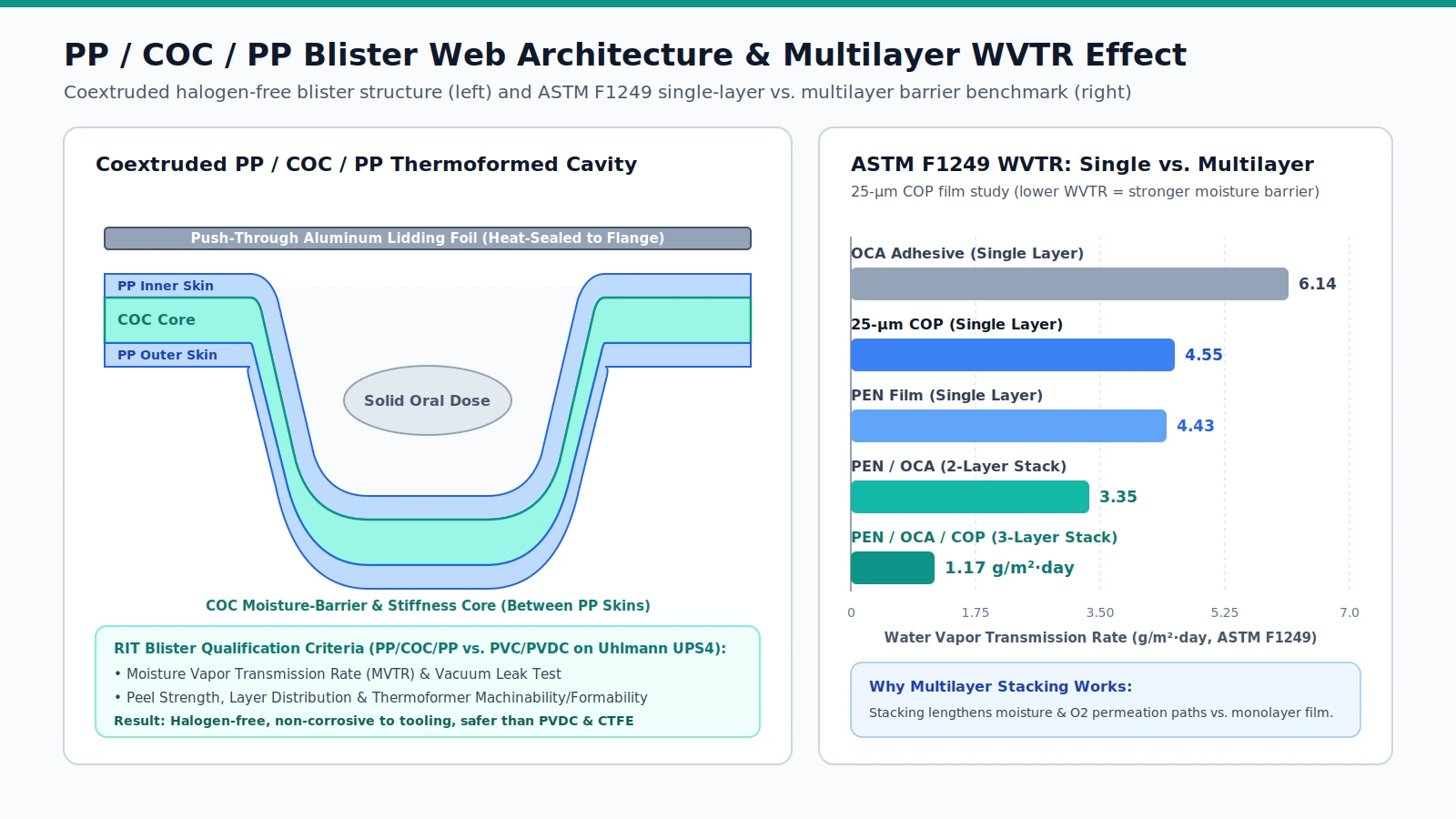
Multilayer architecture also matters because single-layer cyclic olefin films remain permeable to water vapor and gases compared with stacked barriers. In an ASTM F1249 water vapor transmission study of 25-µm COP film, single-layer COP measured 4.55 g/m²·day, whereas a three-layer PEN/OCA/COP structure lowered WVTR to 1.17 g/m²·day by lengthening the moisture and oxygen permeation path (PubMed Central multilayer COP film study).
For a direct comparison of traditional halogenated forming webs and cold-formed foil laminates, review blister packaging materials: PVC, PVDC, and cold-form aluminum.
Which polar versus non-polar solvents govern cyclic olefin copolymer chemical compatibility?
Cyclic olefin copolymer resists water, alcohols, polar organic solvents, acids, and bases, but both COC and COP are generally attacked by non-polar organic solvents such as toluene. In addition, native COC surfaces are hydrophobic and lack functional groups for covalent biologic attachment, requiring UV/O3 or O2 plasma surface activation only when wettability or chemical functionalization is needed.
Treating COC’s high moisture barrier as universal chemical or gas immunity is a common specification error. While moisture absorption stays below 0.01% and polar contact media leave the amorphous matrix intact, non-polar organic solvents can attack both COC and COP (Wikipedia: Cyclic olefin copolymer; PubMed Central ethylene-norbornene study). Formulation excipients, cleaning agents, and ink or adhesive carriers must therefore be screened for non-polar aromatics and hydrocarbons before tooling qualification.
Surface energy works in the opposite direction depending on the application. For parenteral vials and syringes storing insulin or protein therapeutics, a low-energy, nonreactive native surface is desirable. In microfluidic or diagnostic cartridges where hydrodynamic pumping or covalent biologic immobilization is required, native hydrophobicity creates high surface tension and back pressure unless the surface is activated by UV/O3 or O2 plasma (PubMed Central ethylene-norbornene study).
| Exposure or design factor | COC response | Qualification action |
|---|---|---|
| Water and aqueous humidity | Moisture absorption below 0.01%; no dimensional swelling | Verify finished-pack MVTR under target storage conditions |
| Alcohols and polar solvents | Good chemical resistance and barrier | Confirm compatibility with specific cosolvent concentration and contact duration |
| Acids and bases | Very resistant to chemical attack | Suitable for aqueous pH-buffered formulations across standard medical uses |
| Non-polar solvents (for example, toluene) | Attacked (applies to both COC and COP) | Exclude non-polar solvent contact or select an alternative barrier material |
| Native surface energy | Hydrophobic; lacks covalent attachment functional groups | Keep native surface for low-adsorption parenterals; apply UV/O3 or O2 plasma only for fluidics or binding |
| Gamma sterilization (25–100 kGy, 2 kGy/h) | Microstructure shifts (-9.2% at 35 mol% vs +17.9% at 57 mol% norbornene) | Qualify exact TOPAS or COC grade at validated sterilization dose |
| Moisture vs gas permeation | High clear-polymer moisture barrier; single-layer films still permeate gases | Measure ASTM F1249 WVTR and evaluate oxygen barrier separately for oxygen-sensitive drugs |
Sources
- Wikipedia — Cyclic olefin copolymer
- Rochester Institute of Technology — Cyclic Olefin Copolymer (COC) in the Pharmaceutical Industry
- PubMed Central — Gamma Irradiation-Induced Changes in Microstructure of Cyclic Olefin Copolymer (COC) Revealed by NMR and SAXS Characterization
- PubMed Central — Characterization of Activated Cyclic Olefin Copolymer: Effects of Ethylene/Norbornene Content on the Physiochemical Properties
- PubMed Central — Multilayer Cyclo-Olefin Polymer Films for Enhanced OLED Encapsulation