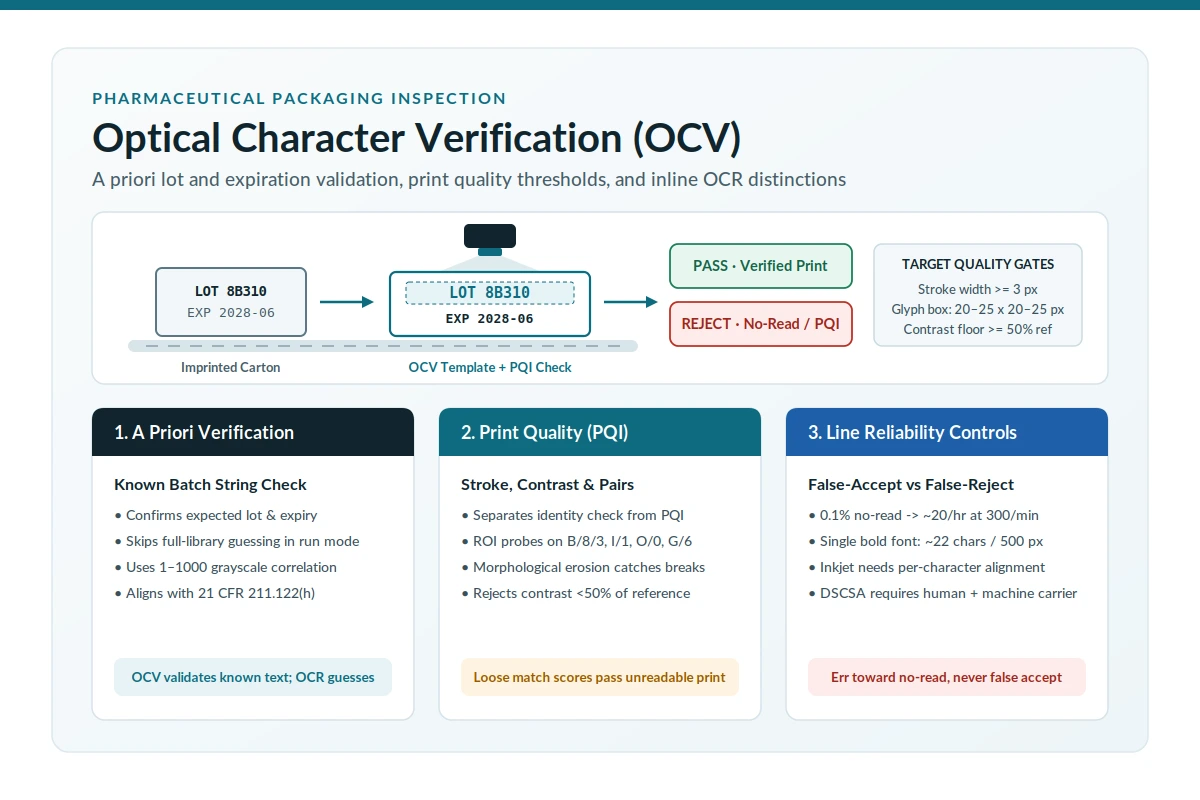
Optical character verification (OCV) is a machine-vision inspection method that uses a priori knowledge of the expected alphanumeric string to validate that every printed lot number and expiration date character on a medicine pack is exactly what it is supposed to be. Unlike optical character recognition (OCR), which searches a character database to guess unknown text, OCV locks each slot to a known reference and pairs identity checks with print quality inspection.
Across pharmaceutical packaging, selecting the right vision mode prevents two costly line failures: letting broken or smudged human-readable dates reach patients, or triggering excessive false rejects from carton motion and ink contrast drift. Aligning OCV thresholds with upstream pharmaceutical serialization and aggregation levels and carton verification gates keeps both human-readable and machine-readable data synchronized.
How does optical character verification differ from optical character recognition on pharmaceutical lines?
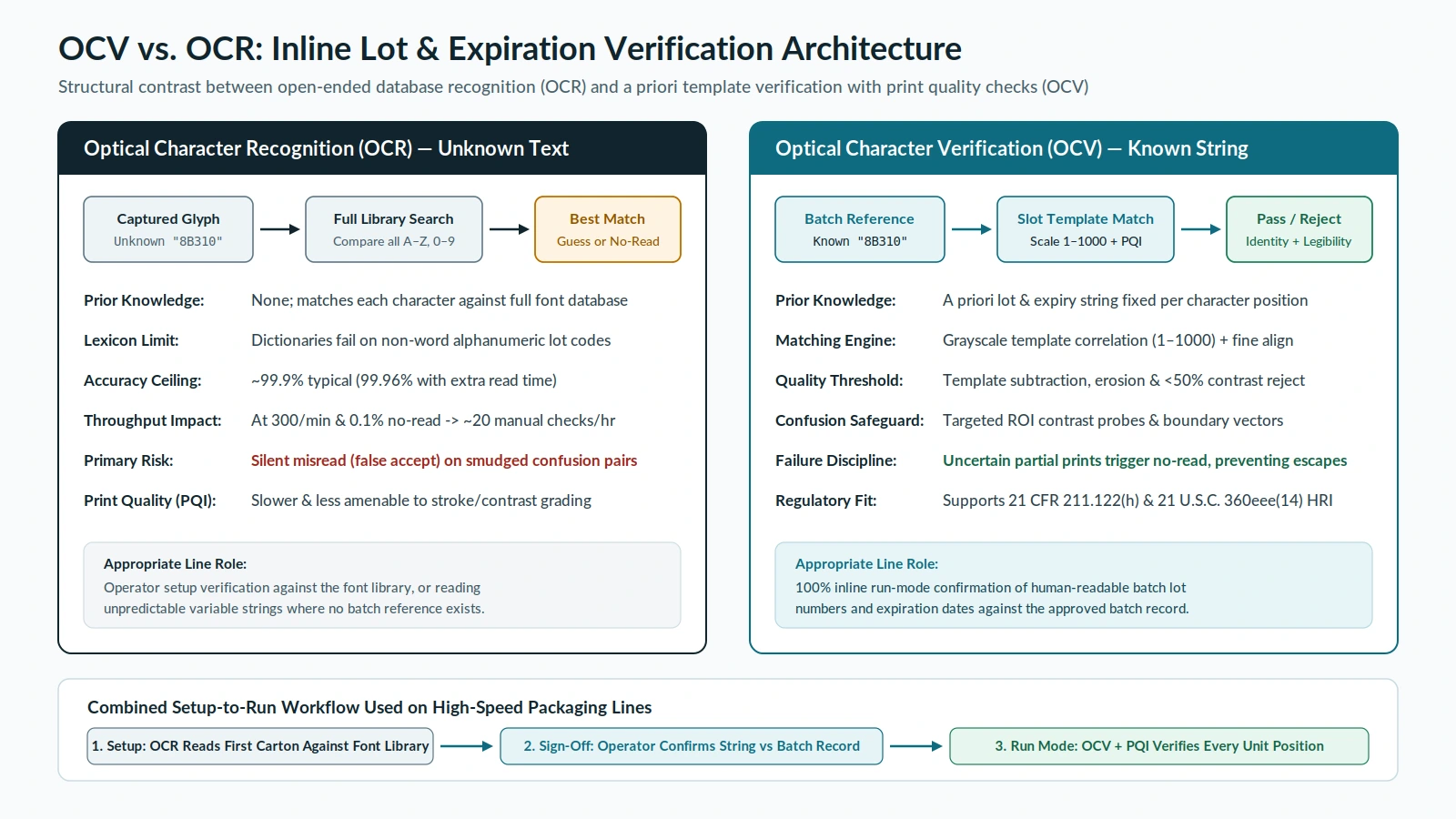
Optical character verification differs from optical character recognition by prior knowledge and decision logic: OCR converts images of typed, handwritten, or printed text into machine-encoded text by comparing each character against every stored pattern in a database and picking the best match, whereas OCV already knows the expected alphanumeric string and validates that the printed glyph matches that exact character.
In optical character recognition, the vision engine searches an entire font library to determine what an unknown character says. That open-ended matching works well when transcribing varied documents, yet on a pharmaceutical packaging line the lot or control number and expiration date are fixed by the active batch record before the first carton prints.
When a packaging line relies on pure OCR during production runs, every character position must be scored against all candidate letters and numerals, slowing processing and increasing sensitivity to print blemishes. By contrast, OCV treats each character position as a known target, comparing the captured imprint directly against the trained template stored for that exact slot.
| Engineering dimension | Optical character recognition (OCR) | Optical character verification (OCV) |
|---|---|---|
| Prior string knowledge | None; reads unknown text from an image | A priori knowledge of the exact expected string per character position |
| Matching mechanism | Compares each glyph against every character in the font database and selects the closest match | Matches each character against its known stored template on a 1 to 1000 correlation scale |
| Lexicon utility | Dictionary post-processing helps prose but struggles with non-word codes and proper nouns | Does not rely on a language dictionary; validates exact batch alphanumeric positions |
| Print quality inspection (PQI) | Generally slower and less amenable to stroke and contrast quality grading | Can pair character alignment with template subtraction, morphological erosion, and contrast rejection |
| Primary packaging-line role | Setup-mode character reading or unreferenced variable text capture | High-speed run-mode verification of batch lot numbers and expiration dates |
When is open-ended optical character recognition used on a line versus strict character verification?
Packaging vision systems frequently use open-ended OCR during operator batch setup and strict OCV during continuous run mode. At changeover, OCR reads the first printed sample against the font library so an operator can confirm on screen that the printer is outputting the correct string, after which run mode locks each slot to OCV template matching.
Setup-mode OCR, algorithmic families, and voting safeguards
Four fundamental algorithmic approaches underpin machine-vision OCR: correlation-based geometric shape scoring, nearest-neighbor decision-theoretic feature classifiers, syntactic or structural vector-relationship analysis, and neural-network or fuzzy-logic classifiers trained by showing examples. All of these approaches except syntactic analysis are font-specific, meaning multi-font training on font-specific models raises confusion-pair errors.
Language lexicons commonly boost OCR accuracy on ordinary documents by restricting output to valid dictionary words (Wikipedia: Optical character recognition). On pharmaceutical cartons, however, lot numbers combine arbitrary letters and digits that do not belong to any standard lexicon, removing dictionary correction as a safety net.
Where open-ended OCR must operate in production—for instance, reading variable strings not locked to a static batch template—engineers tighten reliability with two controls. First, adding a checksum digit forces the parsed digits to satisfy a mathematical rule, catching single-character substitution errors. Second, multi-pass voting allows even a single algorithm suite to read a character 5 to 10 times and accept the result only when a quorum such as at least six reads out of ten agree.
Run-mode OCV on fixed lot and expiration fields
Once setup verification finishes, run-mode OCV eliminates open-ended searching across the font library. The vision controller knows which character belongs in each position of the batch lot number and expiration date, so it aligns the captured imprint and scores each glyph against its specific stored grayscale template on a 1 to 1000 correlation scale, where 1000 represents a perfect match.
If the score exceeds the trained acceptance threshold and passes print quality rules, the pack advances down the conveyor. Integrating that verification signal into the cartoner’s shift register works alongside the component-identity and flap-closure controls detailed in cartoning machine leaflet, pharmacode, and tuck checks.
Why can an OCR engine misread a smudged character unless paired with OCV contrast and stroke checks?
An OCR engine or a loosely tuned OCV shape matcher can misread a smudged character because confirming character identity and assuring print legibility are not mutually inclusive. Even with clear imaging, character-by-character OCR recognition of Latin-script text is still not 100% accurate, and loosening shape-match thresholds to tolerate minor print wear can allow defective or altered glyphs to pass.
Accuracy ceilings and the math of 0.1% errors at line speed
Historical benchmarks of commercial OCR on printed Latin-script newspaper text measured character accuracy between 81% and 99%, confirming that automated reading still needs verification controls (Wikipedia: Optical character recognition). In industrial machine vision under favorable conditions, top OCR systems achieve roughly 99.9% read accuracy—one misread or no-read out of every thousand characters—and with additional read time some systems claim 99.96% accuracy.
That 0.1% error margin compounds rapidly on a high-speed pharmaceutical packaging line. At 300 objects per minute, sorting 0.1% of units as no-reads sends approximately 20 products per hour to manual inspection. That outcome is still the best-case scenario; the worst case occurs when those uncertain characters are silently misread and passed downstream as false accepts.
Confusion pairs and why global match scores fall short
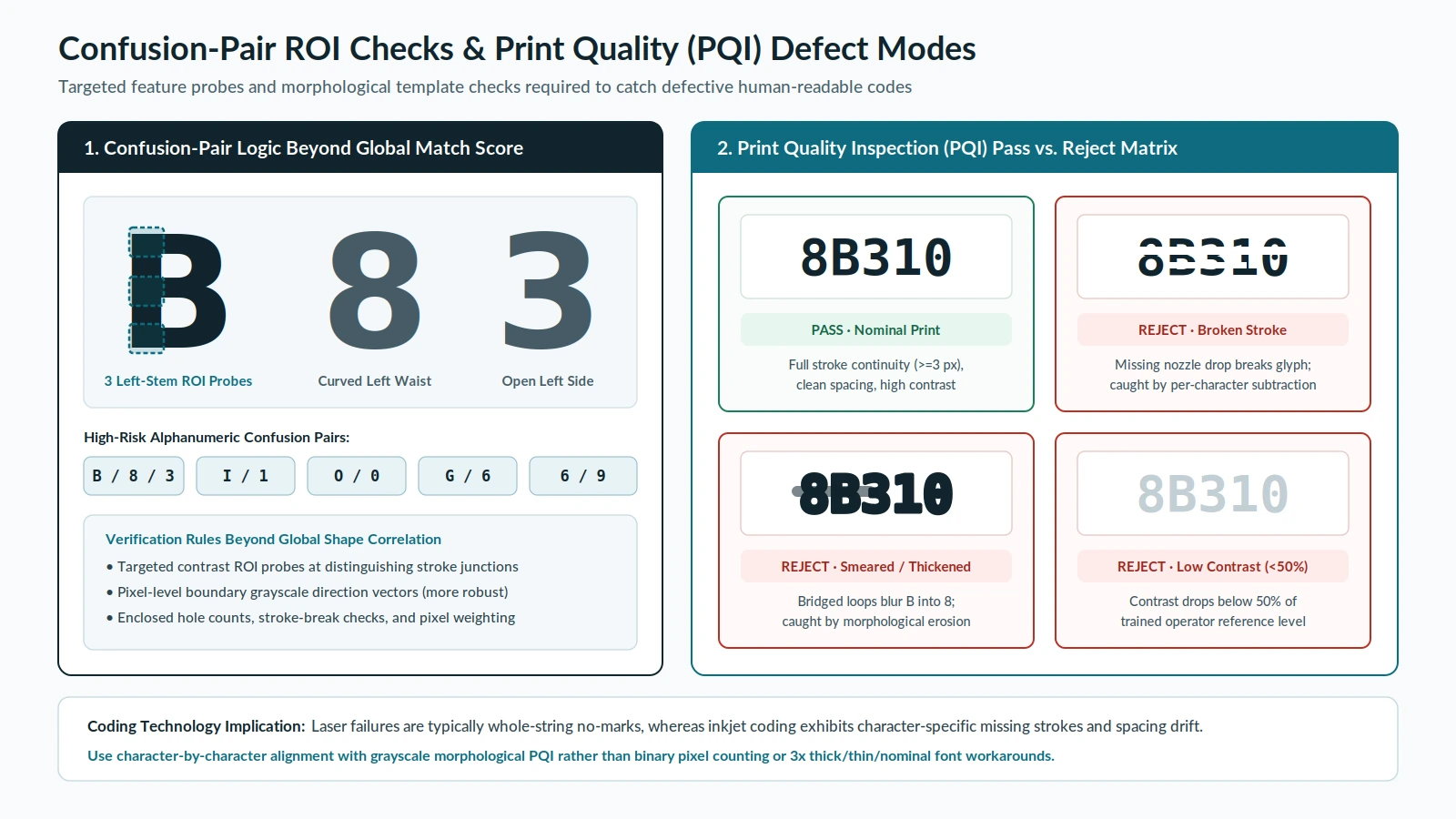
When a vision engineer lowers a global shape-match threshold so slightly thickened, thinned, or partially obliterated strokes do not trigger frequent line stops, two look-alike glyphs can cross into each other’s acceptance zone. The highest-risk alphanumeric confusion pairs include B with 3 or 8, the letter I with numeral 1, G with 6, the letter O with numeral zero, 6 with 9, and 3 with 8.
Reliable OCV systems therefore layer specialized confusion-pair logic on top of correlation scores. One method places targeted regions of interest (ROIs) at distinguishing features—for example, three contrast-checking ROIs along the left vertical stroke of a B to separate it from an 8 or a 3. A more robust approach evaluates boundary direction vectors showing how grayscale intensity changes at every pixel along the character perimeter, supplemented by enclosed hole counts, character-break detection, and pixel weighting.
How does OCV catch broken strokes, missing ink drops, and smeared laser or inkjet characters?
OCV paired with print quality inspection (PQI) catches broken strokes, missing ink drops, and smeared characters by performing fine character-by-character alignment, subtracting the captured imprint from the trained template, applying morphological erosion to evaluate pixel residue, and rejecting any character whose contrast falls below an engineering floor such as 50% of the trained reference.
Grayscale morphological pipelines versus binary pixel counting
Simple OCV implementations binarize the camera image into black foreground and white background pixels and count pixel overlap. While fast, simple binary approaches suffer higher false-reject rates whenever thresholds are tightened to prevent false accepts, and they perform poorly on character quality evaluation.
Rather than relying on binary pixel counting alone, grayscale OCV and PQI systems perform more image processing by combining fine per-character alignment with morphological operations. After aligning both the full string and each individual character, the pipeline subtracts the current imprint from the learned template. A single-pixel erosion removes isolated stray noise pixels, and a second erosion scaled to the engineering thick-thin tolerance compensates for acceptable stroke-width variation while exposing genuine missing strokes or heavy ink bridging.
Grayscale templates also normalize moderate variations in print contrast, background carton color, stroke-width contrast, and lighting non-uniformity across scenes, cutting nuisance rejects without hiding true readability failures. Adding an explicit contrast floor—automatically rejecting characters whose contrast drops below 50% of the level captured during operator training—stops faded coding before it becomes unreadable to pharmacists or patients.
Laser marking versus inkjet coding defect behavior
Coding technology directly determines how template regions must be structured. Some vision setups match sub-regions across an entire multi-character string at once rather than character by character. That shortcut may be adequate for laser marking, where the typical failure mode is a whole-string no-mark condition affecting all characters simultaneously.
Inkjet coding behaves differently: nozzle drop-outs, ink drying, and carton speed fluctuations produce character-specific missing strokes, varying stroke widths, and uneven inter-character spacing. Verifying multiple characters as one pattern weakens confusion-pair isolation and breaks down when character-to-character spacing shifts. Some operators try to work around inkjet stroke variation by training three separate font styles—thick, thin, and nominal—yet that workaround both loosens quality sensitivity and multiplies correlation processing time by three.
| Inspection or coding factor | Simpler binary or whole-string approach | Grayscale character-by-character OCV with PQI |
|---|---|---|
| Primary defect detection strength | Catches whole-string no-mark failures common in laser marking | Catches character-specific missing inkjet strokes, smears, and spacing drift |
| Contrast and lighting tolerance | Sensitive to lighting drift and carton background color variation | Grayscale templates normalize moderate scene-to-scene contrast shifts |
| Stroke-width variation control | Binary pixel counting or 3x thick/thin/nominal font training (slower and looser) | Per-character fine alignment plus configurable morphological erosion |
| Contrast fade safeguard | Relies on static binarization threshold | Supports automatic rejection below 50% of trained reference contrast |
| False-reject behavior at strict settings | Higher false-reject incidence when tightened to block false accepts, especially on inkjet | Lower false-reject rate while maintaining print legibility gates |
What pixel resolution, lighting, font, and substrate factors govern inline OCR and OCV reliability?
Inline OCR and OCV reliability depends on camera resolution, bold single-font geometry, consistent lighting, and tight control of carton motion and surface reflectance. Standard vision rules of thumb specify at least three pixels across the smallest character stroke, a 20 to 25 by 20 to 25 pixel footprint per character, and two pixels of spacing between adjacent characters.
Camera pixel budget and single-font discipline
Pixel sizing immediately bounds how many characters one camera can inspect reliably. At 20 pixels across each character plus two pixels of spacing between characters, a 500-pixel camera field of view accommodates at most about 22 characters—and that ceiling assumes repeatable mechanical positioning with no extra field-of-view margin reserved for locating a drifting string.
Font selection matters just as much as pixel density. Machine-vision OCR and OCV systems generally handle only one font style at a time, and specifying a bold, geometrically distinct single font improves reliability. Dedicated machine-readable typefaces such as OCR-A, OCR-B, and MICR use precisely controlled sizing, spacing, and distinctive character shapes to improve recognition accuracy (Wikipedia: Optical character recognition).
Lighting, artwork clearance, and mechanical motion variables
Lighting is as critical as recognition algorithms in both OCR and OCV. Illumination should yield clean, repeatable separation between character strokes and the carton or label substrate, even as surface finish, reflectance, or carton color hue, saturation, and brightness vary across supplier lots.
Positional uncertainty determines what alignment routines the vision controller runs before scoring characters. Translation and rotation drift may call for a find routine; z-axis distance shifts between the camera lens and printed plane may require scale invariance; non-parallel mounting may call for perspective handling; and curved cylindrical surfaces introduce capture distortion that should be conveyed to prospective vision vendors.
How the system locates the string also interacts with carton artwork. Blob-analysis finders rely on bounding boxes and centroids, making them vulnerable to nearby pre-printed graphics, cutouts, scratches, or extraneous noise close to the coding window. Normalized grayscale correlation and grayscale edge templates anchor fine alignment more reliably when surrounding artwork sits near the lot and expiration field.
| Optical or mechanical parameter | Engineering rule of thumb or boundary | Impact on inline OCV reliability |
|---|---|---|
| Minimum stroke width | At least 3 pixels across the smallest character stroke | Prevents thin strokes from vanishing during binarization or erosion |
| Character footprint | 20 to 25 pixels by 20 to 25 pixels per character | Provides sufficient edge pixels for template correlation and ROI probes |
| Inter-character spacing | At least 2 pixels between adjacent characters | Stops adjacent glyphs from merging during segmentation or inkjet spread |
| Maximum string length in 500-pixel FOV | Roughly 22 characters at 20 px width plus 2 px spacing | Assumes repeatable positioning; add margin if carton position floats |
| Font configuration | Single bold font style with distinct shapes (such as OCR-A or OCR-B) | Reduces confusion-pair overlap and keeps correlation speed high |
| Positional and surface variables | Translation, rotation, z-axis scale, perspective tilt, curved surfaces, reflectance | Defines whether find routines, grayscale edge templates, and invariance tools are required |
When evaluating camera mounts, conveyor guide rails, and printer-to-camera spacing on a new line, integrate these optical constraints into overall packaging-line selection so carton transport stability matches the vision field of view.
Which regulatory controls and reject boundaries apply to human-readable lot and expiration coding?
In the United States, current Good Manufacturing Practice rules require packaging lines to monitor online imprinting against the batch production record, identify drug products with lot numbers and legible expiration dates, inspect finished packs during and after operations, and reject nonconforming labeling—while federal supply-chain tracing law mandates both human-readable and machine-readable product identifiers.
US regulatory basis for human-readable verification
Multiple sections of federal drug manufacturing and supply-chain law connect directly to inline OCV stations on packaging lines:
- Online printing monitoring: Under Section 211.122(h), printing devices on or associated with manufacturing lines that imprint labeling onto drug product unit labels or cases must be monitored to assure that all imprinting conforms to the print specified in the batch production record.
- 100-percent electronic inspection and rejection: For cut labeling on immediate containers, unit cartons, or multiunit cartons, Section 211.122(g)(2) recognizes electronic or electromechanical equipment performing a 100-percent examination during or after finishing operations, while Section 211.122(b) requires rejecting any labeling or packaging material that fails written specifications.
- Lot traceability and line clearance: Section 211.130(c)–(e) requires identifying each drug product with a lot or control number permitting batch history determination, verifying labeling suitability and correctness before operations, and inspecting packaging facilities immediately before use to remove previous drug products and unsuitable materials, with results recorded in batch production records.
- In-process and finished inspection: Section 211.134(a)–(c) mandates examining packaged and labeled products during finishing operations, visually inspecting a representative sample at completion, and recording results in batch production or control records.
- Expiration date legibility and dual carriers: Section 211.137(a) requires stability-based expiration dating, and Section 201.17 requires that expiration dates appear on both the immediate container and the outer package unless easily legible through the outer package (with an exception allowing single-dose containers in individual cartons to carry the date on the individual carton). In parallel, the federal DSCSA product identifier definition in U.S. Code Section 360eee requires the standardized numerical identifier, lot number, and expiration date in both human-readable form and on a machine-readable data carrier.
Setting false-accept and false-reject boundaries in equipment specifications
Because reliable reading across all conditions of partial print or handling abrasion can be impossible, equipment specifications should instruct vision vendors to trigger a no-read signal in the event of uncertainty rather than risking a misread. A complete vision specification defines both the maximum acceptable false-accept (misread) rate and the maximum false-reject (no-read) rate, lists every alphanumeric character and confusion pair in the dataset, locks a single bold font, and documents substrate and lighting variation tolerances.
Translate those OCV resolution, contrast, confusion-pair, and reject criteria directly into testable acceptance fields inside the packaging equipment URS checklist before qualifying a vision station on a pharmaceutical packaging line.