

A procurement policy changes what clinics can buy. A payment rule changes what providers can afford to deliver. Systems thinking examines those connections before choosing an intervention: who makes the decision, who carries it out, and how the result reaches patients.
Governance connects decisions and responsibility
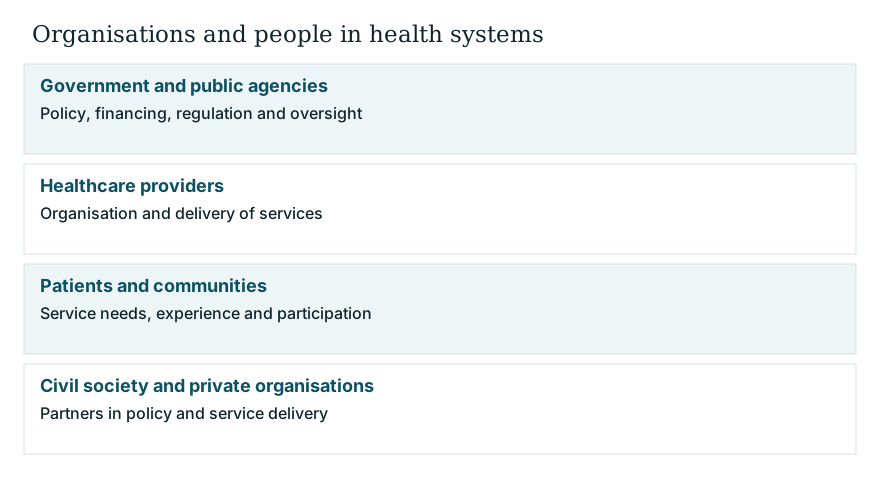
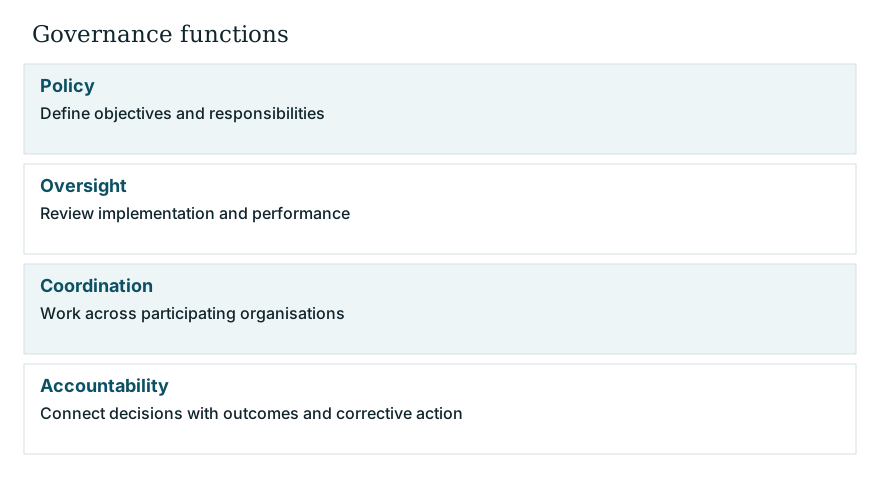
WHO describes health-system governance through policy, oversight, regulation, partnerships and accountability. Government agencies, care providers, patients, communities and private organisations all affect delivery. A policy team therefore needs to trace responsibility across organisations as well as within its own department.
Consider a clinic reporting repeated stock-outs. Purchasing more stock may help, but the investigation also needs to check the ordering process, payment approvals and the route by which supplies reach the clinic. Each explanation points to a different action and a different owner.
| Decision | Operational question | Record to examine |
|---|---|---|
| Procurement | Was the correct product ordered in time? | Order, specification and approval dates |
| Finance | Could the supplier be paid under the agreed terms? | Payment authorisation and outstanding invoices |
| Distribution | Did the released stock reach the intended facility? | Dispatch, receipt and lot records |
| Service delivery | Could staff provide the service when it was needed? | Service availability and interruption records |
Follow the effect through to care
WHO’s universal health coverage framework connects access to needed services with protection from financial hardship. A delivery measure should therefore distinguish a completed administrative task from a service a person can actually use.
For example, an approved purchase order records a procurement decision. A received shipment records a delivery. Neither alone establishes that a patient obtained the medicine at an affordable cost. Keep those measures linked so that improvements at one stage can be checked against the next.
Review an intervention with the people affected
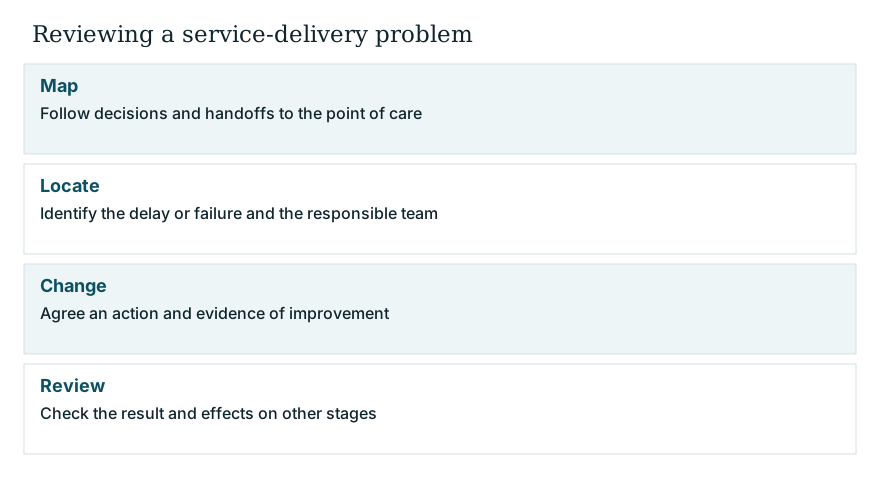
Map the current process, identify the handoff where a delay occurs and assign an owner to the proposed change. Agree what evidence would show improvement, then review whether the change moved the delay elsewhere. Include frontline staff in that review: they can often explain why a procedure that looks straightforward on paper is difficult to carry out.
Use Access to medicines for coverage and affordability measures, and the medicine supply-chain guide for product handoffs.